Veterinarian Career Guide
Explore veterinarian jobs, salaries, and career paths. Stay current on veterinary medicine and animal health research.
Top Veterinary News, in 5 Minutes
We handpick the best veterinary newsletters and distill the latest animal health research and industry news into a 5-minute audio briefing, texted to you every morning.
Try the Veterinarian Briefing, FreeFreeSee the 6 newsletters we handpicked
At a glance
Veterinary Medicine at a Glance
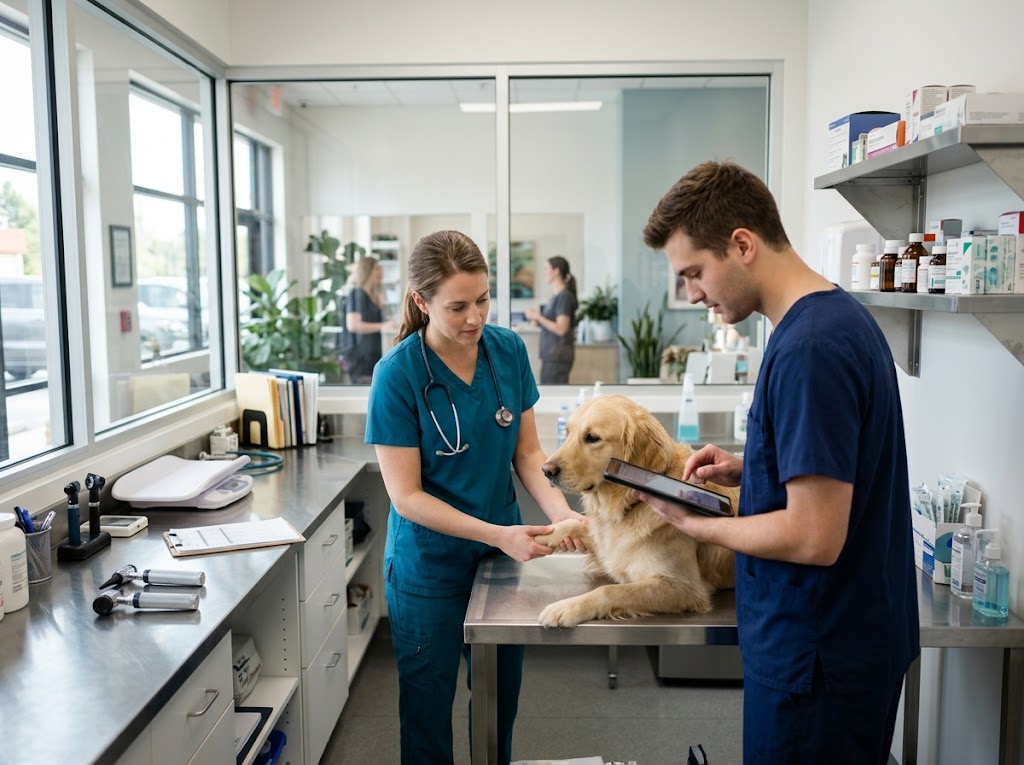
The AVMA counted 133,475 US veterinarians at the end of 2025; federal statistics count 91,100 veterinarian jobs. That gap matters: the licence reaches well beyond the companion animal clinic most people picture. Veterinarians run general practice, perform referral surgery as board-certified specialists, staff emergency and critical care, cover herd health and food safety on farms, certify animals for government, oversee laboratory animal welfare, develop treatments in industry, and teach in 32 accredited colleges. Pay reflects that spread: a $130,100 median in May 2025, the lowest tenth under $73,920 and the top tenth over $215,700, with medians of $129,990 in veterinary services, $121,890 in educational services and $115,210 in government. Employment should grow 9 percent to 2035, about 3,100 openings a year, on a demand base of 88.9 million dogs and 77.0 million cats. The profession rewards more than diagnostic reasoning: surgical nerve, herd-level epidemiology, and giving a prognosis and a price in one breath without making the owner feel judged. Entry is the hard part: the DVM takes four years after a bachelor's degree, admission is competitive, and licensure runs through the NAVLE in every US and Canadian jurisdiction plus a state law exam almost everywhere. Two things shape the career from there, debt and ownership: the class of 2024 averaged a debt-to-income ratio of 1.4, manageable, while 12.3 percent sat above 2.50, which is not, and corporate groups hold an estimated 40 to 50 percent of referral practices.
Key Industry Statistics
$130,100
Median annual pay for veterinarians (May 2025)US Bureau of Labor Statistics
133,475
Veterinarians in the United States (December 2025)American Veterinary Medical Association
+9%
Projected veterinarian job growth, 2025 to 2035US Bureau of Labor Statistics
1.4
Average debt-to-income ratio, veterinary class of 2024American Veterinary Medical Association
Common roles
- Associate veterinarian
- Emergency veterinarian
- Mixed animal practitioner
- Board-certified specialist
- Medical director
- Practice owner
Where they work
- Companion animal clinics
- Emergency and referral hospitals
- Farms and equine yards
- Government and public health
- Animal health industry
- Universities and research
What decides pay
- Ownership stake
- Board certification
- Emergency and out-of-hours work
- Species and setting
- Production-based pay terms
Key Areas in Veterinary Medicine
Companion Animal Practice
The clinic most people picture, and where most veterinarians spend their careers.
Emergency & Critical Care
Overnight and unscheduled medicine, paid accordingly and demanding accordingly.
Referral Specialty Medicine
Board-certified work in 48 recognised specialties, reached through a residency.
Food Animal & Equine
Herd and yard work, with public health duties the exam room never raises.
Public & Regulatory Practice
Inspection, surveillance and disease control, where the patient is a population.
Industry, Research & Academia
Drug development, laboratory animal medicine and teaching the next cohort.
Veterinarian Jobs & Salary
Veterinarians have a real federal occupation code, 29-1131, so this ladder is grounded rather than inferred. It runs from the roles people hold before and alongside the DVM, through the research occupation a veterinary degree most often exits into, to the profession itself. All figures are median annual wages for May 2025.
Veterinary assistants and laboratory animal caretakers
$38,150
Veterinary technologists and technicians
$47,380
Medical scientists
$103,410
Veterinarians
$130,100
Source: US Bureau of Labor Statistics, Veterinarians, May 2025, accessed October 2026.
Veterinary Career Paths
Four routes out of the same degree. The first fork is whether your patient is an individual animal or a population, and the later one is whether you go deeper into a specialty or take on the business.
- Associate Veterinarian0 to 3 yearsBuilding speed on routine surgery and consults, and learning how often you need to ask.
- Senior Associate3 to 7 yearsA developed caseload, your own clients, and the first real say over how cases are run.
- Medical Director7 to 12 yearsThe clinical standard for a whole practice, plus hiring, rotas and the associates who leave.
- Practice Owner10 years and upThe business: valuation, debt, staffing and what the clinic will decline to do.
Credential that fits DVM plus state licence; no further credential required
Veterinarians have their own federal occupation code, 29-1131, with a $130,100 median in May 2025. The supporting roles and the research exit are counted separately, which is why this page quotes veterinary technologists and technicians, veterinary assistants and medical scientists alongside it rather than blending them into one average.
A Typical Day in Veterinary Medicine Jobs
Five roles from a first associate post to running the building, ordered by how much of the day somebody else has already decided.
Associate VeterinarianEntry-Level · Companion AnimalConsults, routine surgery, and the slow discovery of how long things actually take you.
- 08:00Surgery board: two spays and a dental, with the dental booked as though it were simple.
- 09:30Theatre, with a technician running anaesthesia and watching you more closely than you realise.
- 12:30Lunch spent writing up notes from the morning, which is where the hour actually goes.
- 13:30Consults: vaccinations, an itchy dog, and a lameness that needs imaging the owner was not expecting.
- 17:30A call to a senior colleague about a case you are not comfortable sending home.
Mixed Animal VeterinarianMid-Level · Rural PracticeA clinic, a truck, and a caseload that changes species between appointments.
- 06:30Farm call for a down cow, in the dark, with the nearest help forty minutes away.
- 09:00Herd health visit: pregnancy checks and a conversation about margins per head, not per animal.
- 12:00Back at the clinic for small animal consults, in the same boots.
- 15:00Equine lameness workup at a yard, with an owner who has already read three forums.
- 18:00Paperwork for a movement certificate, which is a legal document with your name on it.
Emergency VeterinarianMid-Level · Emergency and Critical CareUnscheduled medicine, triage, and the worst conversations in the profession.
- 18:00Handover: three inpatients, one unstable, and a waiting room that is already four deep.
- 20:00A hit-by-car dog, stabilised while the owner is told what the next twelve hours will cost.
- 23:00A toxin ingestion where the useful question is what time, not what substance.
- 02:00A euthanasia at the owner's decision, done properly, then ten minutes with the nurse who held the cat.
- 06:00Handover written for the day team, honestly, including what you are unsure about.
Board-Certified SpecialistSenior-Level · Referral HospitalCases other veterinarians could not resolve, and the referring relationships that supply them.
- 08:00Rounds with residents on an internal medicine case that has been reframed twice already.
- 10:00A diagnostic procedure under sedation, with the referring practice's notes open beside you.
- 13:00Calling a general practitioner back, which is the part that decides whether they refer again.
- 15:00Reviewing an AI-generated radiology report, and editing it before it is released.
- 17:00Teaching a resident the thing that is not in the textbook, which is why the residency exists.
Practice OwnerSenior-Level · OwnershipA clinical day on top of a business, and the decisions nobody else in the building can make.
- 07:30Numbers before the doors open: revenue per veterinarian, and a rota with a hole in it.
- 09:00Consults, because an owner who stops seeing cases loses the room quickly.
- 12:30A conversation with an associate who is three years in and quietly looking.
- 14:30An unsolicited approach from a corporate group, and the question of what the clinic is worth.
- 16:30Deciding what the practice will not offer, which is the decision ownership is actually for.
JOB SEARCH
How to Become a Veterinarian in 2026
Whether you are working out whether the degree is worth the debt, negotiating your first associate contract, or deciding between a residency, a medical directorship and buying a practice, the questions change at each stage. Pick yours.
Entry-Level
Get Licensed and Survive Year One
What the degree costs against what it pays, how licensure actually works, and what to ask for in a first contract so the first year does not break you.
What you should know about the field
The training, the licence, the pay and the debt, in that order.
Thirty-two accredited US colleges, and admission is competitive
The AVMA Council on Education lists 32 accredited colleges of veterinary medicine in the United States. The DVM takes about four years after a bachelor's degree, and the Council expects 80 percent or more of each college's graduating seniors sitting the NAVLE to have passed by graduation.
Sources: AVMA Council on Education, Accredited Veterinary CollegesUS Bureau of Labor Statistics, Veterinarians, May 2025
Licensure runs through the NAVLE and then your state
The North American Veterinary Licensing Examination is required for licensure in every US and Canadian jurisdiction and is offered in three annual testing windows. Most states add their own exam on state law, and few states accept another state's licence outright.
Sources: International Council for Veterinary Assessment, NAVLEUS Bureau of Labor Statistics, Veterinarians, May 2025
The pay is real, and the spread is wide
Veterinarians had a median wage of $130,100 in May 2025. The lowest 10 percent earned under $73,920 and the highest 10 percent over $215,700, so the national median tells you very little about your own first offer.
Source: US Bureau of Labor Statistics, Veterinarians, May 2025
Debt-to-income is the number that decides your twenties
The average debt-to-income ratio for the class of 2024 was 1.4, up from 1.3 in 2023 but far below the ratios above 2.0 common through much of the 2010s. Within that class, 42.2 percent were at 1.50 or higher and 12.3 percent at 2.50 or higher. AAVMC publishes tuition and median graduate debt school by school, which is the only way to see which side of that average a given college puts you on.
Sources: AVMA, Chart of the Month: New Insights on Student Debt, January 2025AAVMC, Cost Comparison Tool
Skills employers look for
What a practice checks in someone who has not practised unsupervised yet.
Diagnostic reasoning across species you were not warned about
A general practice day can run from a vomiting dog to a budgerigar to a goat. Employers test whether you can work a problem list from first principles rather than recall a protocol you happen to have seen.
Sources: US Bureau of Labor Statistics, Veterinarians, May 2025AVMA, Veterinary Specialties and the American Board of Veterinary Specialties
Surgical confidence at the level the job actually needs
Routine spays, neuters, dentals and mass removals are the volume work of a general practice. Honest self-assessment of what you can do unsupervised matters more to an employer than an inflated case log.
Source: US Bureau of Labor Statistics, Veterinarians, May 2025
Getting licensed on time, in the right jurisdiction
The NAVLE has three testing windows a year with fixed application deadlines and no extensions, and most states add a law exam. Missing a window can cost a graduate months of earnings.
Sources: International Council for Veterinary Assessment, NAVLEUS Bureau of Labor Statistics, Veterinarians, May 2025
Explaining a cost and a prognosis in the same sentence
Owners decide on treatment with their own money, and dog-owning households average $595 a year on veterinary care. The skill is offering a workable plan at more than one price without making either option sound like the wrong answer.
Interview questions and answers
Questions put to a candidate about to practise on their own licence.
Why did you choose veterinary medicine, and what do you want to do in it?
What they are looking for: Whether you have a realistic picture of the work rather than an origin story about loving animals.
I want general small animal practice with enough surgical volume to get properly fast at routine procedures. I came in thinking I wanted wildlife work, did a rotation, and found I preferred the continuity of seeing the same patients for years. I would rather say that than pretend I always knew.
Make it yours: Name what you tried and ruled out. A preference with evidence behind it reads as judgement.
Walk me through how you would work up a vomiting six-year-old dog.
What they are looking for: A structured problem list, not a recalled protocol. The case is deliberately vague.
History first, because duration, diet, toxin access and whether it is bilious changes everything. Then a physical exam looking for abdominal pain or a foreign body. Minimum database next, and imaging if the exam or the bloods point at obstruction. I would say out loud where I would ask for help.
Make it yours: Say where you would escalate. New graduates who claim no limits worry interviewers.
What support would you need in your first year here?
What they are looking for: Self-knowledge, and whether you will ask for help before a case goes wrong.
A named person I can call mid-consult without it being a favour, scheduled surgical supervision for the first few months, and appointment lengths that start longer and shorten as I speed up. I would also want to know how the emergency rota works before I agree to it.
Make it yours: Ask about the rota. Candidates who do not are the ones who leave within a year.
An owner cannot afford the plan you recommended. What do you do?
What they are looking for: Whether you can offer tiered care without either abandoning the patient or shaming the client.
Find out what they can do, then build the best plan inside it rather than presenting the ideal and a gap. Often that is diagnostics in stages, or treating empirically with a clear review point. I would write down what we are not doing and why, so the record and the owner both know.
Make it yours: Describe a second plan, not a discount. Interviewers are testing for a spectrum of care habit.
Mid-Level
Own Your Caseload and Your Contract
Running your own cases, reading the numbers behind your pay, deciding whether a residency is worth the lost earnings, and protecting yourself from the parts of the job that wear people out.
What you should know about the field
What moves your income, your caseload and your options now that you can practise independently.
Where you work moves the number
May 2025 medians by industry: social advocacy organisations $131,760, veterinary services $129,990, educational services $121,890, and government excluding state and local education and hospitals $115,210. Government and academic roles trade pay for stability and, sometimes, for no state licence requirement.
Source: US Bureau of Labor Statistics, Veterinarians, May 2025
Board certification is a second training pathway, not a title
The AVMA recognises 22 specialty organisations covering 48 distinct specialties, and more than 16,500 veterinarians hold diplomate status. Getting there means postgraduate training, education and examination after the DVM, usually an internship then a residency.
Source: AVMA, Veterinary Specialties and the American Board of Veterinary Specialties
The team around you is credentialed too
Veterinary technologists and technicians, at a $47,380 median across 131,400 jobs, and veterinary assistants, at $38,150 across 132,100 jobs, are the people who make a clinic's day work. Both are projected to grow 9 percent to 2035.
Sources: US Bureau of Labor Statistics, Veterinary Technologists and Technicians, May 2025US Bureau of Labor Statistics, Veterinary Assistants and Laboratory Animal Caretakers, May 2025
The non-clinical exit is better paid than people assume
Medical scientists had a $103,410 median across 181,000 jobs in May 2025 and are projected to grow 13 percent to 2035. Pathology, toxicology, laboratory animal medicine and regulatory work are where a DVM goes when the exam room stops fitting.
Sources: US Bureau of Labor Statistics, Medical Scientists, May 2025AVMA, Veterinary Specialties and the American Board of Veterinary Specialties
Skills employers look for
What separates a competent clinician from one a practice builds around.
Working with credentialed technicians properly
A clinic's throughput depends on delegating to technicians who hold their own credential rather than treating them as assistants. The 131,400 technologists and technicians in the workforce are the single biggest lever on how many cases a day you can carry.
Source: US Bureau of Labor Statistics, Veterinary Technologists and Technicians, May 2025
Reading a practice's numbers before you sign with it
Production-based pay, caseload, emergency rota and who owns the clinic all change your income more than a headline salary does. Ownership has consolidated enough that knowing who owns the practice is now part of due diligence.
Sources: JAVMA News, The Corporatization of Veterinary Medicine, November 2018Federal Trade Commission, Final Order on JAB Consumer Partners' Acquisition of SAGE Veterinary Partners, August 2022
Handling euthanasia and conflict without absorbing it
BLS describes the work as emotionally stressful and physically demanding, with bites, kicks and disease exposure. The AVMA runs profession-level wellbeing and suicide prevention programmes, which is a measure of how real this is.
Sources: US Bureau of Labor Statistics, Veterinarians, May 2025AVMA, Wellbeing Resources for Veterinary Professionals
Managing debt as a deliberate plan
With an average debt-to-income ratio of 1.4 and more than a tenth of the class of 2024 above 2.50, repayment strategy, employer assistance and loan forgiveness are career decisions rather than paperwork.
Source: AVMA, Chart of the Month: New Insights on Student Debt, January 2025
Interview questions and answers
Questions that test judgement under a real commercial constraint.
How do you feel about production-based pay?
What they are looking for: Commercial literacy, and whether you understand how your income is actually generated.
It rewards efficiency, and it can quietly reward overtreating, so I want to know the base, the production percentage, the negative accrual rules and the caseload the clinic can realistically feed me. I am comfortable with it when the numbers are transparent and the schedule supports the volume.
Make it yours: Ask about negative accrual by name. Very few candidates do, and it signals you have read a contract.
Tell me about a clinical mistake and what changed afterwards.
What they are looking for: Honesty and whether a system changed, rather than just a resolution to be careful.
I missed a retained testicle on a pre-surgical exam and found it mid-procedure. The fix was not resolving to palpate harder, it was adding the check to the surgical consent conversation so it is confirmed twice before the animal is under. I told the owner the same day.
Make it yours: Describe the system you changed. An apology with no process change is the weak answer.
How do you work with credentialed veterinary technicians?
What they are looking for: Whether you delegate properly, which determines how many cases the clinic can carry.
I ask what they are trained and licensed to do here, then use it, because a technician running anaesthesia and catheter placement is the difference between six surgeries and three. I give them the plan and the reasoning, not just the task, so they can flag when something looks wrong.
Make it yours: Say you ask first. Assuming scope differs by state and by practice is an easy credibility loss.
Why a residency, and why now?
What they are looking for: Whether the cost of several low-paid postgraduate years has been reckoned with honestly.
Because the cases I want are referral cases, and I have confirmed that over three years in practice rather than assumed it. I have modelled what the training years do to my loan balance and I can carry it. If that maths had not worked I would have stayed in general practice and said so.
Make it yours: Show the arithmetic. Residency answers that skip the money sound like they have not been made yet.
Senior-Level
Set the Standard, or Buy the Building
Deciding what the practice will and will not do, keeping associates who have debt and options, judging the technology before it judges your radiographs, and working out what consolidation did to the price of ownership.
What you should know about the field
What seniority in this profession is actually accountable for.
Ownership has consolidated, especially in referral
JAVMA News reported 28,000 to 32,000 US practices, of which Brakke Consulting estimated about 3,500 were company-owned, roughly 10 percent of general companion animal practices and 40 to 50 percent of referral practices. Mars alone then owned more than 2,000 hospitals.
Source: JAVMA News, The Corporatization of Veterinary Medicine, November 2018
Regulators now watch veterinary deals
The FTC required JAB Consumer Partners to divest clinics in Austin, San Francisco and the Oakland area as a condition of its $1.1 billion purchase of SAGE Veterinary Partners, and imposed prior approval and prior notice on its future specialty and emergency clinic acquisitions.
AI arrived in imaging before anyone wrote the rules
An AVMA panel described radiology as AI's proving ground in veterinary medicine and called for best-practice standards, while the AVMA created a Task Force on Emerging Technologies and Innovation. The AAVSB's position is that licensees must understand AI's limits and disclose its use.
Sources: AVMA News, Building a Framework for Responsible AI in Veterinary Medicine, November 2025AAVSB, Regulatory Considerations of the Use of Artificial Intelligence in Veterinary Medicine, March 2025
Wellbeing is a stated profession-level priority
The AVMA treats veterinary wellbeing as a top priority and publishes suicide prevention resources, crisis lines and workplace tools for practices. Treating burnout as a personal failing rather than a known occupational hazard is a mistake this profession has already named.
Source: AVMA, Wellbeing Resources for Veterinary Professionals
Skills employers look for
What is expected of someone others take their standard from.
Valuing and running a practice as a business
Corporate buyers look for multi-veterinarian practices generating at least $1.2 million a year, which is also a working definition of a practice that can support an owner. Knowing where yours sits against that is the ownership conversation.
Source: JAVMA News, The Corporatization of Veterinary Medicine, November 2018
Mentoring new graduates who are carrying debt
The people you supervise arrive with a debt-to-income ratio that shapes what they can say no to. Senior veterinarians who build genuine case support, and name it in an offer, keep associates for years rather than months.
Sources: AVMA, Chart of the Month: New Insights on Student Debt, January 2025AVMA, Wellbeing Resources for Veterinary Professionals
Judging an AI tool before it judges your radiographs
AI radiograph review is already in clinics, and the AAVSB expects licensees to understand its limits, maintain transparency and obtain informed consent where appropriate. The veterinarian stays accountable for the report either way.
Sources: AVMA News, Building a Framework for Responsible AI in Veterinary Medicine, November 2025AAVSB, Regulatory Considerations of the Use of Artificial Intelligence in Veterinary Medicine, March 2025
Committing to a residency, or deciding not to
Board certification through one of 22 recognised organisations means years of postgraduate training and an examination, taken at low pay while debt accrues. Choosing it, or choosing general practice on purpose, is a career decision not a default.
Source: AVMA, Veterinary Specialties and the American Board of Veterinary Specialties
Interview questions and answers
Questions for someone expected to have an independent view of the profession.
Would you want to own a practice, and what would make that work?
What they are looking for: Whether you understand ownership as a business decision rather than an escape from employment.
Yes, on the condition that the practice can support it: enough veterinarians and revenue to pay a manager and a locum, not a single-vet clinic where I am the business continuity plan. I would also want to understand what a corporate buyer would pay for it, because that sets the price I have to beat.
Make it yours: Price the alternative. Ownership answers that ignore what consolidation did to valuations sound dated.
How do you think about working for a corporate group versus an independent practice?
What they are looking for: A considered view, since the ownership question is now unavoidable in this profession.
They are different trades rather than a good and a bad option. Groups usually bring better equipment, structured CE and a real rota; independents usually bring more say in how medicine is practised. I would ask the same questions of both: who decides the case load, and who decides when we say no.
Make it yours: Refuse the easy villain. A flat anti-corporate answer reads as inexperience, not principle.
How would you keep an associate who is three years in and burning out?
What they are looking for: Retention thinking, which is the hardest problem a medical director owns.
Find out whether it is hours, case mix, clients or money, because the fixes are different. Usually it is rota density plus no decompression after hard cases. I would change the schedule first because it is the fastest real signal, then build in case debriefs, then look at pay against what their debt actually requires.
Make it yours: Diagnose before you offer money. A raise applied to a rota problem buys about four months.
How would you evaluate an AI diagnostic tool a practice wanted to buy?
What they are looking for: Technology judgement and a clear grasp of who remains accountable.
I would ask what data it was validated on, whether it explains its finding or just asserts it, and whether the output is marked as needing review before it is final. Then I would run it alongside our existing reads for a period. The licence holder signs the report either way, so an opaque tool is a liability.
Make it yours: Name validation and accountability. Enthusiasm without either is the answer regulators are worried about.
Why Veterinarians Need to Stay Informed
New treatments, diagnostic technologies, and animal health research are changing veterinary care. Staying current on clinical advances, disease outbreaks, and industry developments helps veterinarians make informed decisions, improve patient care, and grow their careers.
Read more
There is a second, less comfortable reason. The ownership of veterinary practices has changed fast enough that the FTC now imposes prior approval requirements on a private equity buyer's future acquisitions of specialty and emergency clinics. Reading the industry coverage is how a clinician finds out what is happening to their own employer before a staff meeting does.
The bottom line
Veterinary Care Is Advancing Faster Than Clinics Can Absorb It.
The medicine will keep improving and the business around it will keep changing hands. A veterinarian who tracks both reads a new diagnostic and a new owner the same way: as something that will reach their exam room, and is better understood before it does than after.
Stay Informed with Hark's Veterinarian Briefing
How it works
Curated from the best newsletters
Hark's editorial team handpicks the sources worth following. See how we rank
Distilled into one briefing
Six sources become a single five-minute read of what actually changed.
Texted to you every morning
It arrives before your first appointment, at a time you choose.
Links back to the original
Every item names its source, so you can read the full piece when it matters.

The 6 Veterinary Newsletters We Handpicked
You May Also Like
- DentistsThe closest parallel profession: a clinical doctorate, heavy student debt, and the same argument about independent ownership against corporate groups.
- NursesShift work, emotional load and a credentialed clinical ladder, covering the hospital side of the care comparison veterinary technicians are often measured against.
- PharmacistsAnother doctoral licence where consolidation changed the employer landscape, and where prescribing judgement meets a counter full of cost conversations.
- Healthcare ManagersWhat a medical director or practice owner is really doing: staffing, margins and clinical standards, read from the management side of a clinic.
Frequently Asked Questions
Entry-Level
What does a veterinarian do?
Diagnoses, treats and prevents disease in animals, and carries legal responsibility for the decisions involved. In general practice that is consultations, routine and emergency surgery, dentistry, diagnostic imaging, laboratory interpretation and prescribing. Beyond the clinic, veterinarians work in food safety, disease surveillance, research, regulatory roles and academia. Most work full time and often more than 40 hours a week, with nights, weekends or emergency cover depending on the setting.
How do you become a veterinarian?
Earn a Doctor of Veterinary Medicine degree from an accredited college, then become licensed. The DVM generally takes four years and includes classroom, laboratory and clinical components, with the final year usually spent on clinical rotations. Applicants typically hold a bachelor's degree in a field such as biology, and admission is competitive. Licensure requires passing the national examination, and most states add an exam on their own laws and regulations.
Is veterinary medicine a good career?
On the numbers, yes, with a real caveat. Median pay was $130,100 in May 2025, employment is projected to grow 9 percent to 2035, and the work is genuinely skilled and varied. The caveat is cost and strain: the class of 2024 carried an average debt-to-income ratio of 1.4, and the AVMA runs profession-wide wellbeing and suicide prevention programmes because the emotional load is a known occupational hazard rather than a personal weakness.
How long does it take to become a veterinarian?
About eight years after secondary school for most people: roughly four years of undergraduate study, then four years of veterinary school. Board certification adds more, because it means postgraduate training, education and examination after the DVM, usually an internship followed by a residency. Licensure itself is quick once you have the degree, but the national exam runs in three fixed annual windows, so the timing of that matters.
What degree do you need to become a veterinarian?
A Doctor of Veterinary Medicine, from a college accredited by the AVMA Council on Education. There are 32 accredited colleges in the United States. The degree is the only route to a licence to practise, and it is a doctoral or professional degree in the federal classification, which is why the training length looks more like medicine or dentistry than like a master's.
What are the requirements for getting into veterinary school?
Typically a bachelor's degree with the prerequisite science coursework, strong grades, and documented hands-on experience with animals and with veterinarians. Admission is competitive. Beyond the transcript, colleges look for evidence that the applicant knows what the work is, which is why clinical, farm, shelter or research hours matter so much, and why the AVMA Council on Education's standards reach into how the colleges assess outcomes.
How competitive is veterinary school admission?
Competitive enough that BLS names it as a feature of the path, and structurally so: there are only 32 AVMA-accredited colleges of veterinary medicine in the United States, against a national applicant pool. We will not quote an applicant-to-seat ratio, because no current national figure is published that we could verify, and the ones circulating online are years out of date. The honest guidance is that the constraint is seats rather than ability, that per-school admission rates vary widely, and that documented hours with veterinarians are what separate comparable transcripts.
How much does veterinary school cost?
There is no single national number worth quoting, because total tuition swings enormously between resident, non-resident and international status at the same college. AAVMC publishes the only honest answer, a per-school Cost Comparison Tool carrying total tuition for the class of 2025, scholarship aid, cost of living, estimated loan interest on a fully financed education and median debt for 2025 graduates. The figure that actually decides your twenties is not the sticker price but the ratio: the AVMA put the class of 2024 at an average debt-to-income of 1.4, with 12.3 percent above 2.50.
Mid-Level
Can you become a veterinarian without going to veterinary school?
No. Every US and Canadian licensing jurisdiction requires graduation from an accredited veterinary programme and passage of the national examination. Graduates of non-accredited foreign colleges can qualify through additional certification pathways, but there is no route that skips veterinary education itself. Adjacent careers, veterinary technician, veterinary assistant, practice manager, animal scientist, are real careers, not shortcuts to the same licence.
What is the difference between a veterinarian and a veterinary technician?
The veterinarian diagnoses, prescribes, performs surgery and carries the legal responsibility. The technician is a credentialed professional, usually holding a two-year associate degree or a four-year bachelor's for technologists, who runs anaesthesia, places catheters, takes radiographs, performs dentals and handles nursing care. Median pay in May 2025 was $130,100 for veterinarians and $47,380 for technologists and technicians.
How much do veterinarians earn?
The median was $130,100 a year in May 2025. The lowest 10 percent earned less than $73,920 and the highest 10 percent more than $215,700. By industry the medians were $131,760 in social advocacy organisations, $129,990 in veterinary services, $121,890 in educational services and $115,210 in government excluding state and local education and hospitals. Ownership, emergency work and referral practice sit in the upper band.
What are the best entry-level jobs for aspiring veterinarians?
Veterinary assistant and laboratory animal caretaker is the most direct, at a $38,150 median across 132,100 jobs and open on a high school diploma, which makes it the cheapest way to find out whether you want the work before you borrow for it. Credentialing as a veterinary technician, $47,380 across 131,400 jobs on a two-year associate degree, goes deeper and pays while you apply. Shelter, farm, research and zoo roles all generate the documented hours admissions committees look for, and a veterinarian's reference from any of them carries more weight than another semester of grades.
What is the job outlook for veterinarians?
BLS projects 9 percent growth from 2025 to 2035, much faster than the average for all occupations, with about 3,100 openings a year over the decade from growth and from people leaving the occupation. The supporting roles are growing at the same 9 percent rate. Underlying it is household pet ownership and the veterinary spending that comes with it, which is a steadier demand base than most professions have.
What are the different types of veterinarians?
By species: companion animal, equine, food animal, mixed practice, laboratory animal and zoological. By setting: general practice, emergency and critical care, referral specialty, government and public health, industry, research and academia. By credential, the AVMA recognises 22 specialty organisations covering 48 distinct specialties, and more than 16,500 veterinarians hold diplomate status in one or more of them.
What is the difference between a small animal and large animal veterinarian?
Small animal practice is mostly dogs and cats in a clinic, with a caseload driven by household pet ownership: 43.7 percent of US households own a dog and 34.1 percent a cat. Large animal practice means travelling to farms and yards, working on equids or food and fibre animals, with more herd health, more regulatory contact and more physical risk. Mixed practice does both, and is common in rural areas.
What is the NAVLE, and how do you become a licensed veterinarian?
The North American Veterinary Licensing Examination is the national examination required for licensure in every US and Canadian jurisdiction, administered by the ICVA in three annual testing windows with fixed application deadlines and no extensions. Passing it is not the whole licence: most states also require an examination on their own laws and regulations, and few states accept another state's licence outright.
Senior-Level
Do veterinarians need to complete an internship or residency?
Not to practise. A licensed veterinarian can go straight into general practice after the DVM. Internships and residencies are the route to board certification, which the AVMA's American Board of Veterinary Specialties awards after postgraduate training, education and examination. More than 16,500 veterinarians hold diplomate status, which is a small fraction of the profession, so most veterinarians never do a residency.
What is the typical veterinarian career path?
Associate veterinarian, then senior associate with a developed caseload, then either medical director or practice ownership. The parallel route is internship, residency and board certification into referral practice. A third route leaves the exam room for industry, government, research or academia, where medical scientists had a $103,410 median across 181,000 jobs in May 2025. Lateral movement between these is common and not treated as a step back.
What are the highest-paying veterinary specialties?
Federal data does not break pay out by specialty, so be sceptical of any list that claims precision. What the published data does show is the shape: the top 10 percent of veterinarians earned more than $215,700 in May 2025, and that band is concentrated in referral specialty work, emergency and critical care, and practice ownership. Board certification runs through 22 recognised organisations and 48 distinct specialties.
What are the biggest challenges of working as a veterinarian?
Debt against income, with the class of 2024 averaging a 1.4 ratio and 12.3 percent above 2.50. Emotional load, which BLS describes plainly and which the AVMA addresses with profession-level wellbeing and suicide prevention resources. Physical risk from bites, kicks and disease exposure. And loss of control, as ownership consolidates: Brakke Consulting estimated corporate groups held 40 to 50 percent of referral practices.
How do you prepare for a veterinarian job interview?
Arrive able to describe your real surgical and diagnostic competence without inflating it, because the first year is where overclaiming becomes dangerous. Prepare questions about the emergency rota, appointment lengths, the mentoring structure and how pay is calculated, since production-based arrangements change your income more than the headline number. Know who owns the practice, and ask who decides caseload.
What are common veterinarian interview questions?
Walk me through your workup for a common presenting complaint. What would you do when an owner cannot afford the plan. What support do you need in your first year. Tell me about a clinical mistake and what changed afterwards. How do you work with credentialed technicians. How do you feel about production-based pay. Most of them test judgement and self-awareness rather than recall.
How do veterinarians start or buy their own veterinary practice?
Usually by buying into the practice they work in, or buying a retiring owner's clinic, financed against the practice's earnings. Consolidation changed the arithmetic: JAVMA News reported that corporate buyers look for multi-veterinarian practices generating at least $1.2 million a year, which raised valuations for exactly the practices an associate would want. The realistic routes now are a smaller clinic, a partnership buy-in, or a start-up.
How are AI, new treatments, and diagnostic technologies changing veterinary medicine?
Imaging first. An AVMA panel described radiology as AI's proving ground, with software classifying and reporting radiographs and vendors building review steps so a veterinarian clears the output before it is final. The AVMA has created a Task Force on Emerging Technologies and Innovation, and the AAVSB's position is that licensees must understand AI's limits, be transparent about its use, protect client data and obtain informed consent where appropriate.
Get Tomorrow's Veterinary Briefing
Six sources, one briefing, five minutes a morning. Enough to walk into your first appointment knowing what changed overnight in the medicine and in the business around it.