Nursing Career Guide
Explore nursing jobs, salaries, and career paths. Get interview tips and stay current on nursing news and trends.
The Top Nursing News, in 5 Minutes.
We handpick the best nursing newsletters and distill key news and insights into a 5-minute audio briefing, texted to you every morning.
Try the Nursing Briefing, FreeFreeSee the 6 newsletters we handpicked

At a glance
Nursing at a Glance
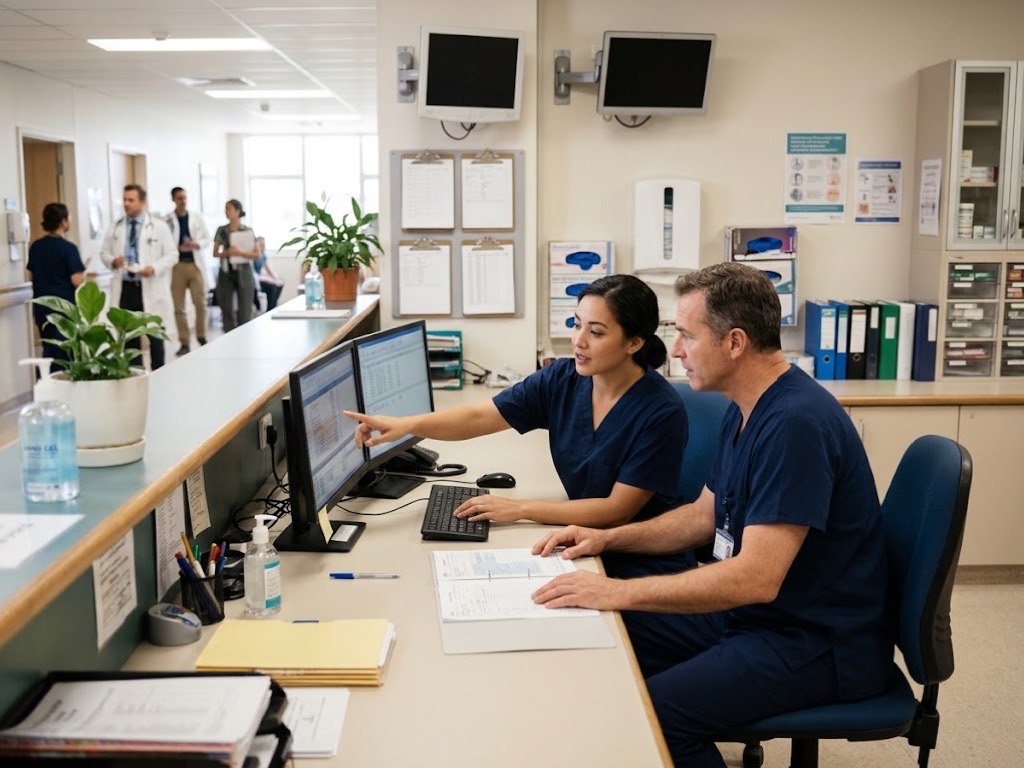
Nursing is the largest clinical workforce in the United States: about 3.47 million registered nurses were employed in 2025, alongside roughly 667,000 licensed practical and vocational nurses and over 1.5 million nursing assistants and orderlies. The common picture of the job, a nurse on a hospital floor, covers only part of it. Registered nurses also work in clinics, schools, prisons, home health, public health departments, insurers, device companies and research. The specialisms are genuinely different jobs sharing one licence: critical care nurses who manage unstable patients minute to minute, perioperative nurses who run the sterile field, emergency nurses who triage and stabilise, oncology nurses who deliver and monitor cytotoxic therapy, informatics nurses who configure the systems everyone else charts in, and nurse practitioners who diagnose and prescribe. Pay and progression follow education more sharply than in most fields. The median registered nurse earned $97,550 in May 2025; nurse practitioners earned $132,300 and nurse anesthetists $236,590, both of which require a master's degree or beyond. The strengths the work rewards are not only clinical: the nurses who advance fastest tend to be the ones who can hold a difficult conversation, defend a judgement to a physician, and teach the person behind them.
Key Industry Statistics
3.47M
Registered nurses employed in the US (2025)US Bureau of Labor Statistics
$97,550
Median annual pay, registered nurses (May 2025)US Bureau of Labor Statistics
180,800
Projected RN openings each year to 2035US Bureau of Labor Statistics
86.7%
First-time US-educated NCLEX-RN pass rate (2025)NCSBN
Common roles
- Registered Nurse
- Charge Nurse
- Nurse Practitioner
- Clinical Nurse Specialist
- Nurse Manager
- Nurse Informaticist
Where nurses work
- Hospitals
- Outpatient clinics
- Home health
- Schools and public health
- Insurers and payers
- Industry and research
Credentials that matter
- RN licence (NCLEX-RN)
- BSN
- MSN or DNP
- Specialty certification
- BLS, ACLS, PALS
Key Areas in Nursing
Acute & Critical Care
Unstable patients, continuous monitoring, rapid escalation when something changes.
Perioperative
Surgical patients before, during and after theatre, including the sterile field.
Emergency
Triage, stabilisation and disposition under time pressure and uncertainty.
Ambulatory & Primary
Ongoing conditions managed across visits in clinics and physician offices.
Advanced Practice
Diagnosing, prescribing and managing a panel as an NP, CRNA or CNS.
Informatics & Quality
The systems, data and standards the rest of the workforce charts in.
Nursing Jobs & Salaries
Federal wage data measures occupations rather than seniority, so this ladder is read as education and scope rather than years served. Every figure is the May 2025 median from the Occupational Outlook Handbook.
Nursing assistants and orderlies
$41,870
Licensed practical and vocational nurses
$64,400
Registered nurses
$97,550
Nurse practitioners
$132,300
Nurse anesthetists
$236,590
Source: US Bureau of Labor Statistics, Occupational Outlook Handbook, May 2025 wage data, accessed October 2026.
Nursing Career Paths
Nursing is not one ladder. It is four tracks that share a licence and then diverge sharply in what they reward, what they pay and how much of the day is spent with patients.
- New Graduate RN0 to 2 yearsBuild assessment speed and safe medication practice under a preceptor. Measured on reliability, not range.
- Staff Nurse, Specialty2 to 5 yearsCarry a full assignment in one specialty and start taking the harder patients without being asked.
- Senior / Preceptor5 to 9 yearsTeach new graduates and absorb the complicated admissions. The first work that is about other people.
- Charge Nurse8 or more yearsRun the shift: allocation, escalation and the unexpected admission. Judgement about the unit, not the patient.
Credential that fits Specialty certification in the area you intend to stay in
There is no federal occupation code for a charge nurse, a clinical informatics nurse or a chief nursing officer. Nurse managers and above are counted under medical and health services managers, which is why the leadership figures on this page come from that occupation rather than from nursing.
A Typical Day in Nursing Jobs
Five roles that carry most of the profession's headcount, ordered from the first rung to advanced practice. The schedules are representative rather than universal: acuity, unit and employer move everything.
Nursing AssistantEntry-Level · Bedside SupportThe continuous presence at the bedside, and usually the first person to notice that something about a patient has changed.
- 07:00Handover, then a first round: who needs help to move, who has not eaten, who looks different from yesterday.
- 08:30Personal care and mobility. The work that prevents pressure injuries and falls, which is most of the job's clinical value.
- 11:00Observations, recorded accurately. These are the numbers a registered nurse will escalate from.
- 13:00Meals and hydration, documenting intake for the patients where it matters clinically.
- 16:00Report anything that changed to the nurse. Saying it out loud beats leaving it in the chart.
Registered Nurse, Medical-SurgicalEntry to Mid · InpatientSeveral patients at once, each on a different trajectory, with the day shaped by medication rounds, assessments and discharges.
- 07:00Handover and a rapid safety round: lines, drains, oxygen, anyone who looks worse than handed over.
- 08:00Medication round. The highest-risk hour of the shift and the one most often interrupted.
- 10:00Full assessments and documentation, plus the ward round where your observations change a plan.
- 13:00Discharges and admissions, which arrive together and rarely when convenient.
- 17:00Second medication round, chart review, and a handover that carries the judgement, not just the numbers.
Critical Care NurseMid-Level · Intensive CareOne or two unstable patients with continuous monitoring, where the work is titration and the feedback is immediate.
- 07:00Detailed handover at the bedside: every line, every infusion, every parameter and its trend.
- 08:00Full systems assessment and equipment safety checks. Everything is verified rather than assumed.
- 10:00Multidisciplinary round. You hold the overnight detail nobody else has.
- 12:00Titration against targets, with sedation, pressors and ventilation adjusted continuously.
- 16:00Family conversation, often the hardest and most valuable thirty minutes of the shift.
Charge NurseSenior-Level · Unit LeadershipResponsible for the shift rather than a patient load: allocation, escalation and absorbing whatever arrives unplanned.
- 06:45Build the assignment against acuity and skill mix, not just numbers. This decides how the day goes.
- 08:00Walk the unit. You are looking for the patient nobody has flagged yet.
- 11:00Bed management and admissions, negotiating what the unit can safely take.
- 14:00Support the escalation your newer nurses are hesitating over, and make the call yourself if needed.
- 18:00Staffing for the next shift, and the incident or complaint that has to be written up today.
Nurse PractitionerAdvanced Practice · Clinic or SpecialtyAn appointment panel of your own: diagnosing, treating and prescribing, with the accountability that comes with it.
- 08:00Review the list, the results that landed overnight and anything needing action before clinic starts.
- 08:30Appointments. History, examination, differential and a plan, usually inside twenty minutes.
- 12:00Prescribing, referrals and the documentation that makes both defensible.
- 14:00Complex or follow-up patients, where continuity is the thing the role actually offers.
- 17:00Results review and the callbacks nobody else will make if you do not.
JOB SEARCH
How to Get a Nursing Job in 2026
Whether you are qualifying, moving specialty, or deciding between advanced practice and management, the same three questions decide it: what the field expects of you now, what you can already evidence, and how you answer for it in a room.
Entry-Level
Start Your Nursing Career
What the licence actually permits, which first roles exist, how the exam works, and what a nurse manager expects from someone with no track record yet.
What you should know about the field
The shape of the profession, what it pays, and the exam standing between you and the licence.
What the registered nurse licence actually covers
A registered nurse assesses patients, plans and delivers care, administers medication, operates and interprets monitoring, documents everything, and coordinates the other disciplines involved. The licence is general: it does not name a specialty, which is why the same credential supports an intensive care unit, a school and an insurer's review desk.
The Bureau of Labor Statistics records a bachelor's degree as the typical entry-level education and about 3,465,400 registered nurses employed in 2025. Associate-degree entry remains common and legal in every state, so read 'typical' as the direction employers are moving rather than a bar you must clear to start.
The three nursing licences, and which one you are choosing
Nursing assistants and orderlies support activities of daily living and basic observations, with a median wage of $41,870 in 2025. Licensed practical and vocational nurses provide nursing care under supervision, at $64,400. Registered nurses carry independent assessment and care planning, at $97,550.
The gap between the LPN and RN medians is about $33,000 a year for roughly a year or two more of education, which is the single most consequential arithmetic in an early nursing career.
Pay is set by licence, specialty and geography, in that order
The May 2025 medians run $41,870 for nursing assistants, $64,400 for LPNs, $97,550 for registered nurses, $132,300 for nurse practitioners and $236,590 for nurse anesthetists. Each step up is an education step, not a seniority step.
That matters for planning. Waiting for a raise inside one licence returns far less than moving to the next one, and the employers most willing to fund that move are the large systems that need the capacity.
The NCLEX-RN, in the numbers rather than the folklore
In 2025, 192,916 first-time US-educated candidates sat the NCLEX-RN and 167,272 passed, a rate of 86.7 percent. The exam is adaptive: average test length was 103 items, average testing time two hours and fourteen minutes, and 59.1 percent of candidates finished at the minimum number of items.
The repeat rate tells the more useful story. First-time US-educated candidates pass at 86.7 percent; repeat candidates at 52.7 percent. Sitting the exam before you are ready is expensive in a way the first attempt is not.
Skills employers look for
What a nurse manager is actually checking on a new graduate, beyond the licence itself.
Structured assessment
Safe medication practice
Escalation and handover
Interview questions and answers
Questions new graduates actually get, and what the manager is listening for underneath them.
Tell me about a patient whose condition changed on your shift.
What they are looking for: Whether you noticed early, what you did, and who you told. They are testing escalation instinct, not diagnosis.
On a med-surg placement my patient's respiratory rate drifted from 18 to 26 across two sets of observations while everything else looked normal. I did a full set early, found the saturation had fallen two points, and called the charge nurse rather than waiting for the next round. It turned out to be an early pneumonia.
Make it yours: Use a real deterioration, however small, and make the timeline explicit. The answer is ruined by jumping to the diagnosis and skipping what you saw first.
How do you prioritise when four patients need you at once?
What they are looking for: A stated framework rather than a promise to work harder. Airway and circulation before comfort, and delegation where it is appropriate.
I take thirty seconds to sort them: anything airway, breathing or circulation goes first, then time-critical medication, then everything else. I delegate what the assistant can legally do, and I tell the patients who are waiting roughly how long, because most of the complaints are about silence rather than the wait.
Make it yours: Name your actual framework and include delegation. Managers are listening for whether you will drown quietly.
What would you do if you thought a physician's order was unsafe?
What they are looking for: That you will raise it, through whom, and that you will not simply comply. This is a patient-safety screen.
I would check I had not misread it, then raise it directly with the prescriber with the specific reason. If I was not satisfied I would escalate to the charge nurse and use the chain of command rather than administering it. I would document the conversation.
Make it yours: Say the words chain of command. Answers that stop at 'I would ask them about it' read as someone who will give way.
Why this unit, and where do you want to be in five years?
What they are looking for: Whether you have a reason for this specialty and whether your plan involves them. Turnover in the first two years is expensive.
I want acute medical because I want the volume and the range early, and I would rather build assessment speed somewhere with a strong preceptor than specialise before I can recognise normal. In five years I would like to be precepting and working toward a critical care certification.
Make it yours: Give a reason rooted in the work, not the roster. Vague ambition reads as a stepping stone.
Mid-Level
Deepen and Specialise
How to convert competence into a specialty, a certification and the first responsibilities that are about other people rather than your own patients.
What you should know at this stage
Where the money and the autonomy actually move once you are past the first two years.
Advanced practice is the largest pay step available
Nurse practitioners, nurse midwives and nurse anesthetists are grouped by the Bureau of Labor Statistics at a median of $134,920 against $97,550 for registered nurses, and the group is projected to grow 36 percent from 2025 to 2035 against 6 percent for RNs.
Within the group the spread is wide: nurse practitioners at $132,300, nurse midwives at $134,040 and nurse anesthetists at $236,590. All three require a master's degree, so the decision belongs in mid-career while the opportunity cost is lowest.
Specialty certification is the mid-career credential
Certification is how a specialty claim becomes legible to an employer who has not worked with you. It is usually built from a licence, a minimum number of practice hours in the specialty and an exam, which is why it cannot be front-loaded and why it marks the mid-career stage rather than the start.
The practical sequence is to pick the specialty you intend to stay in, accumulate the hours deliberately rather than incidentally, and sit the exam while the clinical detail is current.
Leadership roles are a different occupation, with different pay
Nurse managers and directors are counted by the Bureau of Labor Statistics under medical and health services managers, a 640,400-job occupation with a median of $123,860 and projected growth of 24 percent to 2035.
It is worth seeing that as a change of profession rather than a promotion. The work becomes budgets, rosters, recruitment and regulatory compliance, and the clinical hours fall away. Nurses who miss that tend to leave the role within two years.
The nursing shortage is a distribution problem
Registered nursing is projected to grow 6 percent to 2035, about as fast as average, with roughly 180,800 openings a year. Most of those openings come from replacement rather than growth.
That is why national shortage language and a hard local job market can be true at once, and why mid-career mobility, between specialties, settings and regions, is the lever that actually works.
Skills employers look for
What separates a competent nurse from the one a unit is organised around.
Precepting and teaching
Running a shift, not just a patient load
Working the record and the data
Interview questions and answers
Mid-career questions, where the subject shifts from your competence to your effect on others.
Tell me about a time you changed how your unit did something.
What they are looking for: Evidence you operate above your own assignment, and that you can carry colleagues rather than complain about them.
Our handover regularly overran because it happened at the bedside for every patient including the stable ones. I proposed a split: a two-minute board round for everyone, bedside handover only for the unstable or newly admitted. I trialled it on my own shifts for a month, took the timings to the manager, and it became the unit standard.
Make it yours: Pick something you actually measured. Changes with no before-and-after read as opinions that happened to win.
How do you handle a colleague whose practice you think is unsafe?
What they are looking for: Whether you will act, how proportionately, and whether you understand the difference between a conversation and a report.
If it is a one-off and not harmful I speak to them directly and privately the same shift, because it is usually workload. If it is a pattern, or a patient was at risk, I document it and take it to the manager. I would not let it sit because I did not want the conversation.
Make it yours: Show the escalation ladder and a bias to the direct conversation first. Managers distrust both extremes.
Why this specialty, and what would make you leave it?
What they are looking for: Self-knowledge and realistic expectations. They are forecasting whether you will still be here in three years.
I moved to critical care because I would rather manage two unstable patients deeply than eight stable ones. What would make me leave is sustained unsafe ratios, because the thing I value about the specialty stops being available.
Make it yours: Answer the second half honestly. A nurse with no conditions reads as someone who has not thought about it.
Walk me through a time you escalated and were wrong.
What they are looking for: Whether you can be wrong out loud. Over-escalation is far safer than under-escalation and they want to hear you know it.
I called a rapid response for a patient whose confusion I thought was neurological. It turned out to be hypoglycaemia, caught and corrected in minutes. I would call it again on the same information, because the cost of being wrong that way is a conversation and the cost of the other way is a stroke.
Make it yours: Choose a case where you would repeat the decision, and say so. That is the point of the question.
Senior-Level
Lead, Prescribe or Build
The three directions senior nursing actually goes: advanced clinical practice, management of people and budgets, or the systems and data the workforce runs on.
What you should know at this stage
The senior routes diverge sharply, and each is a different labour market.
Advanced practice pays most and is growing fastest
The nurse anesthetist, nurse midwife and nurse practitioner group is projected to grow 36 percent from 2025 to 2035, far above the 6 percent for registered nurses, at a group median of $134,920. Nurse anesthetists alone sit at $236,590.
The entry requirement is a master's degree, and the constraint at this stage is rarely ability. It is the two to three years of reduced earnings while you train, which is why the decision gets harder every year it is deferred.
Management is a 640,400-job occupation of its own
Medical and health services managers had a median of $123,860 in May 2025 and are projected to grow 24 percent to 2035. Nurse managers, directors of nursing and chief nursing officers are counted here.
The ceiling is higher than bedside nursing and the floor is lower: a first-line nurse manager may earn little more than a senior staff nurse working overtime, while carrying responsibility for a budget, a roster and regulatory compliance.
Informatics and industry are the quiet third route
Nurses move into system configuration, quality and safety, clinical education, payer utilisation review, device and pharmaceutical companies and research coordination. These roles are not separately counted by the federal statistics, which is precisely why they are under-competed.
AACN's own work maps informatics and healthcare technologies as a core domain of nursing education, which is a signal about where the profession expects this to sit.
Accountability for AI stays with the licensed nurse
The American Nurses Association's position statement on the ethical use of artificial intelligence in nursing practice is filed under Ethics and Human Rights, not technology, and that placement is the argument: a tool can draft a note or compute a deterioration score, but the professional judgement and the accountability remain the nurse's.
At senior level this becomes a governance question. Someone has to decide which tools reach the bedside, how overrides are recorded, and what happens when a score is wrong.
Skills employers look for
What a system is buying when it hires a senior nurse rather than an experienced one.
Budget and roster literacy
Regulatory and accreditation fluency
Technology governance
Interview questions and answers
Senior questions, where the subject is the unit, the budget and the people rather than the patient.
How would you reduce turnover on a unit losing staff?
What they are looking for: A diagnosis before a solution, and awareness that pay is rarely the whole story. This is the central problem of nursing leadership.
I would start with exit and stay interviews, because the reasons people give on the way out and the reasons they give while still there differ. In most units it is schedule predictability and feeling unsupported in the first year rather than pay. I would fix the preceptor model first, since it is cheap, then take a ratio or scheduling case to finance with the turnover cost attached.
Make it yours: Lead with the diagnosis and attach a number to the proposal. Executives fund arguments with a cost of inaction.
Tell me about a safety event you were accountable for.
What they are looking for: Whether you can discuss harm without defensiveness or blame, and whether you changed the system rather than the person.
A medication error reached a patient on my unit. On review the contributing factor was two look-alike concentrations stocked side by side. I reported it, supported the nurse involved through the review, and had the stocking changed and the second concentration removed from the floor. The individual conversation mattered far less than the shelf.
Make it yours: Choose a real one, name your own accountability, and land on the system change. Blaming the nurse disqualifies you.
How do you decide whether a new clinical technology is safe to adopt?
What they are looking for: Governance instinct. They want to know you will neither block everything nor wave something through because it demos well.
I ask what it was validated on and whether that population resembles ours, how an override is recorded, who reviews the misses, and what the fallback is when it is unavailable. The accountability stays with the nurse either way, so if we cannot explain to a nurse why it said what it said, it is not ready for the bedside.
Make it yours: Make the accountability point explicitly. It is the professional position and senior interviewers are listening for it.
What is your case for more staff, to a CFO who has heard it before?
What they are looking for: Translation. Whether you can convert a clinical argument into the language of cost, risk and regulation.
I would bring the cost of our vacancy and agency spend against the cost of the posts, the turnover cost per nurse lost, and the quality indicators that move with ratios. Then I would ask for a time-limited trial on one unit with agreed measures, because a pilot is easier to fund than a permanent uplift.
Make it yours: Bring the comparison and ask for something bounded. Open-ended requests get deferred indefinitely.
Why Nurses Need to Stay Informed
AI-powered clinical tools, changing care models, staffing challenges, and new treatment guidelines are reshaping nursing. Staying informed helps nurses strengthen patient care, adapt to emerging technologies, and advance their careers.
Read more
The second reason is economic. Reimbursement rules, system consolidation and labour agreements decide how many nurses a unit is funded for, and those decisions are reported weeks before they reach a schedule.
The bottom line
Nursing Is Evolving Fast. Stay Ahead.
The federal projections and the work point the same way. Registered nursing is projected to grow 6 percent to 2035 with about 180,800 openings a year, while nurse practitioner roles grow 36 percent. The demand is there; the advantage goes to nurses who see the changes coming.
Stay Informed with Hark's Nursing Briefing
How it works
Curated from the best newsletters
Hark's editorial team handpicks the sources worth following. See how we rank
The news that matters in 5 minutes
Hark distills the most important stories into a concise audio briefing.
Texted to you every morning
You set the time and listen when you want.
Go deeper if you want
Upgrade to the 15-minute briefing and select up to 50 newsletters.

The 6 Nursing Newsletters We Handpicked
STAT Morning Rounds
STAT
- Free
- Daily
STAT's free daily rundown of health, medicine, and life-sciences news from one of the best newsrooms on the beat, delivered every weekday morning.
Why nurses read it
The clinical and biomedical read: trials, drug approvals and FDA decisions, written for people who will encounter them at the bedside rather than for investors.
More about this newsletter
Morning Rounds is STAT's flagship morning email: health, medicine, and life-sciences news reported by the best newsroom on the beat, with real sourcing and a fast news sense. It is the insider's first read of the day. Free, unlike much of STAT's site.
Best for: Insiders who want the first, best-sourced read of the day on health, medicine, and life sciences from STAT's newsroom.
MedPage Today
MedPage Today (Everyday Health Group)
- Free
- Daily and specialty-dependent
Clinician-focused breaking medical news, conference coverage, and specialty updates built for fast professional scanning.
Why nurses read it
Clinical news organised by specialty, which is how a nurse actually reads it. Useful for tracking guideline changes in the area you work rather than medicine in general.
More about this newsletter
MedPage Today is a working journalist newsroom covering clinical trials, drug approvals, medical policy, and healthcare investigations, with daily email briefings by specialty. The voice is news-desk pragmatic, written for physicians but readable by anyone in healthcare. Best for readers who want practicing-clinician news rather than consumer health content.
Best for: Physicians and healthcare professionals who want news-desk pragmatic coverage of clinical trials, drug approvals, and policy by specialty.
See the other 4 newsletters
Healthcare Dive Daily Dive
Industry Dive
- Free
- Daily (weekdays)
- 170k readers
Industry Dive's free weekday rundown of hospital, payer, and health-policy news, the trade read for the business side of healthcare.
Why nurses read it
The business of care delivery: payers, staffing, closures and the economics that decide how many nurses a unit is funded for. The context behind your own ratios.
More about this newsletter
Healthcare Dive is Industry Dive's free weekday briefing on the business of healthcare: hospitals, payers, policy, and the deals between them. Its advertising page claims 170,000 newsletter subscribers. A trade read that non-insiders can follow.
Best for: Non-insiders and professionals alike who want a free, digestible weekday briefing on hospitals, payers, policy, and healthcare dealmaking.
Becker's Hospital Review
Becker's Healthcare
- Free
- Daily for Hospital Review; specialty lists 1–5× weekly
- 1M readers
Fast, executive-level intelligence on hospital operations, finance, leadership, regulation, and healthcare strategy.
Why nurses read it
Hospital operations seen from the administration side, including staffing, labour disputes and system consolidation. Read it to know what is coming before it reaches your unit.
More about this newsletter
The industry tip sheet for hospital executives, delivering high-volume daily coverage of health system M&A, leadership changes, finance, and operations in punchy list-driven briefs. The voice is fast trade journalism, breadth over depth. Indispensable for anyone working in or selling to hospitals; overkill for casual health readers. Multiple specialty editions (CFO, Health IT, Clinical) are available from the same signup.
Best for: Hospital executives and vendors who need high-volume daily coverage of health system M&A, leadership moves, and operations in punchy briefs.
Fierce Healthcare
Questex
- Free
- Daily (weekdays)
Daily healthcare industry news: payers and providers, health system finances, policy and regulation, and the technology being deployed across them.
Why nurses read it
Policy, payers and health system strategy, with reliable coverage of the regulatory changes that reshape documentation and reimbursement requirements for frontline staff.
More about this newsletter
The broadest daily read on the healthcare business, and strongest on the payer side that provider-focused titles tend to skip.
Best for: Anyone who needs payers, providers and policy in one daily brief.
HealthLeaders Briefing
HealthLeaders (HCPro)
- Free
- Daily (weekdays)
Healthcare leadership coverage aimed at executives: hospital finance and margin, workforce and staffing, clinical operations and payer relations.
Why nurses read it
Written for healthcare leadership, which makes it the most useful of the six if you are moving toward charge nurse, nurse manager or any role with a budget attached.
More about this newsletter
Written for the people running hospitals rather than the people reporting on them, which makes it unusually direct about margin and staffing.
Best for: Healthcare managers and executives who want operations and finance, not clinical research.
You May Also Like
- DoctorsThe clinical colleagues you escalate to, and a useful comparison if you are weighing advanced practice against medical school as a route to diagnosing and prescribing.
- PharmacistsMedication expertise from the other side of the order, covering the training, the licensure and the retail-to-clinical shift that has reshaped that profession.
- Healthcare ManagersWhere nurse managers and directors are counted in the federal statistics, so this is the honest picture of the leadership track's pay and growth.
- Health TechClinical informatics, digital health and the companies building the tools that arrive at the bedside, which is the industry route out of direct care.
Frequently Asked Questions
Entry-Level
Is nursing a good career in 2026 and beyond?
On the federal numbers, yes. Registered nursing is projected to grow 6 percent from 2025 to 2035 with about 180,800 openings a year, at a median of $97,550 in May 2025. The stronger case is above the RN line: nurse practitioners, midwives and anesthetists are projected to grow 36 percent at a group median of $134,920. The caution is that most RN openings come from replacement rather than growth, so the shortage is about distribution and retention as much as volume.
What types of nursing careers and specialties are available?
One licence supports very different jobs. Acute and critical care manage unstable patients; perioperative nursing runs the surgical pathway; emergency nursing triages and stabilises; ambulatory and primary care manage long-term conditions across visits; oncology, paediatrics, psychiatric and maternal health are distinct clinical worlds. Beyond the bedside there is informatics, quality and safety, education, public and occupational health, utilisation review for insurers, research coordination, and industry roles with device and pharmaceutical companies.
How do you become a registered nurse (RN) in 2026?
Complete an approved nursing programme, either an associate degree or a bachelor's, then pass the NCLEX-RN and apply to your state board for licensure. The Bureau of Labor Statistics lists a bachelor's degree as the typical entry-level education, though associate entry remains legal and common everywhere. Many employers, particularly magnet hospitals and academic centres, prefer or require a BSN, and some will fund the bridge if you start with an associate degree.
What is the difference between an RN, LPN/LVN, and nurse practitioner?
They are three licences with different scope and pay. Licensed practical and vocational nurses provide nursing care under supervision, at a median of $64,400. Registered nurses carry independent assessment, care planning and coordination, at $97,550. Nurse practitioners hold a master's degree and diagnose, treat and prescribe, at $132,300, with prescriptive authority varying by state. Each step is an education step rather than a seniority step.
Should you pursue an ADN or BSN to start a nursing career?
Both lead to the same licence and the NCLEX outcomes are close: in 2025, first-time US-educated baccalaureate candidates passed at 87.6 percent and associate-degree candidates at 86.1 percent. The difference is employability and ceiling, not exam readiness. The BSN is the typical entry-level education BLS records, is preferred by many large systems, and is a prerequisite for graduate study. An associate degree is the faster and cheaper route in, and bridging later is well-trodden.
What are the admission requirements for nursing school?
Requirements are set by the programme and the state board rather than nationally, but the common pattern is prerequisite science coursework in anatomy, physiology, microbiology and chemistry, a minimum grade point average, an entrance exam, a background check, immunisation records and sometimes healthcare experience. Competitive programmes ration places on the prerequisite grades, so those courses matter more than the application essay.
How difficult is the NCLEX, and how should you prepare for it?
Difficult but passable first time: 192,916 first-time US-educated candidates sat the NCLEX-RN in 2025 and 86.7 percent passed. It is computer adaptive, so it finds your level rather than asking everyone the same questions. Average test length was 103 items and average testing time two hours and fourteen minutes, with 59.1 percent finishing at the minimum item count. The number that should shape your preparation is the repeat rate: 52.7 percent. Sitting before you are ready is costly.
Mid-Level
What are the best entry-level nursing jobs for new graduates?
Medical-surgical and acute medical units remain the standard first post because the volume and range build assessment speed quickly, and a strong preceptor matters more than the specialty name. New graduate residency programmes, where a system runs a structured first year, are worth choosing over a higher hourly rate elsewhere. Step-down and telemetry units are a common route toward critical care.
How much do registered nurses earn, and which specialties pay the most?
The median registered nurse earned $97,550 in May 2025. The highest-paid nursing work is advanced practice: nurse anesthetists at $236,590, nurse midwives at $134,040 and nurse practitioners at $132,300, all requiring a master's degree. Within staff nursing, pay is driven more by employer, region and shift differential than by specialty, which is why geographic and sector moves usually beat waiting for a raise in place.
What is the difference between working in a hospital, clinic, and outpatient setting?
Hospitals offer acuity, shift work, structured progression and the widest range of specialties, with nights, weekends and holidays. Clinics and physician offices run closer to office hours with lower acuity and more continuity with the same patients. Outpatient procedural settings sit between the two: high throughput, predictable hours and a narrow clinical range. Pay generally follows acuity and unsocial hours rather than setting alone.
How do you choose the right nursing specialty for your skills and interests?
Decide the variables you want rather than the diagnosis you like: how many patients at once, how fast the feedback is, how much continuity you want, and how much uncertainty you can carry. Someone who prefers two unstable patients deeply belongs in critical care; someone who wants to know a panel over years belongs in ambulatory or primary care. Float or per diem shifts in a candidate specialty answer the question faster than reading about it.
What certifications are most valuable for advancing a nursing career?
The one that matches the specialty you intend to stay in. Certification generally requires a licence, a minimum number of practice hours in that specialty and an exam, so it cannot be front-loaded and is the natural mid-career credential. Life support certifications such as BLS, ACLS and PALS are usually employer requirements rather than advancement. For leadership, a management or executive nursing credential signals the shift from clinical to administrative work.
How do you prepare for a nursing job interview, including clinical scenario questions?
Have three or four real patient stories ready with the timeline intact, including what you noticed first and who you told. Scenario questions test escalation instinct and prioritisation rather than diagnosis, so state a framework out loud: airway, breathing and circulation, then time-critical medication, then the rest, with delegation named. Expect a safety question about an unsafe order, and answer it with the chain of command. Have a reason for this unit specifically.
What does a typical day look like for nurses in different specialties?
It varies more than any other profession with one licence. A med-surg nurse carries several patients through medication rounds, assessments and discharges. A critical care nurse manages one or two unstable patients with continuous monitoring and frequent titration. An emergency nurse works in undifferentiated arrivals and disposition decisions. An ambulatory nurse runs a clinic list with continuity across visits. A nurse practitioner carries an appointment panel, diagnosing and prescribing.
Senior-Level
What clinical, communication, and technology skills do employers expect from nurses?
Clinically: structured head-to-toe assessment, safe medication practice and recognition of deterioration. In communication: structured escalation and handover that gets a busy clinician to act, plus difficult conversations with families and colleagues. In technology: fluency in the electronic record as clinical work rather than paperwork, and increasingly the ability to explain what an automated early-warning score is computing and why you agreed or overrode it.
How do nurses transition into advanced practice roles such as NP, CRNA, or CNS?
All three require graduate education, a master's degree at minimum, usually with a clinical hour requirement and national certification afterwards. The practical sequence is to accumulate relevant experience in the target specialty, keep the grade point average and references in order, and apply while earning. Anesthesia programmes are the most competitive and typically require critical care experience. The real obstacle is rarely admission; it is the two to three years of reduced earnings, which is why the decision belongs in mid-career.
What career opportunities exist for nurses outside direct patient care?
Clinical informatics, quality and patient safety, infection prevention, nursing education and staff development, case management and utilisation review for insurers, legal nurse consulting, research coordination, public and occupational health, regulatory affairs, and clinical roles with device and pharmaceutical companies. Most are not separately counted in the federal statistics, which is part of why they are less competed for than bedside posts.
How is AI changing nursing documentation, patient monitoring, and clinical decision support?
The first contact for most nurses is documentation and scoring: ambient tools that draft a note from the encounter, and early-warning algorithms that flag deterioration from data you entered. The American Nurses Association's position statement on the ethical use of artificial intelligence in nursing practice makes the governing point, and its filing under Ethics and Human Rights rather than technology is deliberate: the tool may compute, but professional judgement and accountability remain with the nurse. In practice, reviewing AI-drafted output is becoming part of charting rather than a task after it.
Which AI tools and healthcare technologies should nurses understand in 2026?
Less a product list than a set of categories: the electronic record and its ordering and documentation layers, ambient or assistive documentation, automated early-warning and sepsis scoring, remote and continuous monitoring, and the governance around all of them. AACN runs a standing hub for AI in nursing education and maps it to Essentials Domain 8, informatics and healthcare technologies, which is a reasonable guide to what the profession expects a nurse to understand.
How can nurses manage workload, prevent burnout, and maintain patient safety?
Treat it as a system problem as well as a personal one. Individually: protect sleep around shift rotation, use the escalation routes rather than absorbing unsafe assignments silently, and keep documentation current during the shift. Structurally, the American Nurses Association maintains position statements on nurse fatigue and on a registered nurse's rights when considering a patient assignment, which exist precisely because the answer cannot be individual resilience alone.
How do experienced nurses advance into charge nurse, nurse manager, and executive leadership roles?
The usual sequence is precepting, then charge shifts, then a formal management post. It is worth understanding that this is a change of occupation: nurse managers and directors are counted under medical and health services managers, a 640,400-job occupation with a median of $123,860 and projected growth of 24 percent to 2035. The work becomes budgets, rosters, recruitment and compliance, and clinical hours fall away. A first-line manager may earn little more than a senior staff nurse working overtime, while carrying far more accountability.
Get Tomorrow's Nursing Briefing
Six sources, one briefing, five minutes a morning. Enough to walk onto the unit already knowing what changed.