TLDR
“The most disciplined five minutes in tech, and the rare briefing that never runs long.”
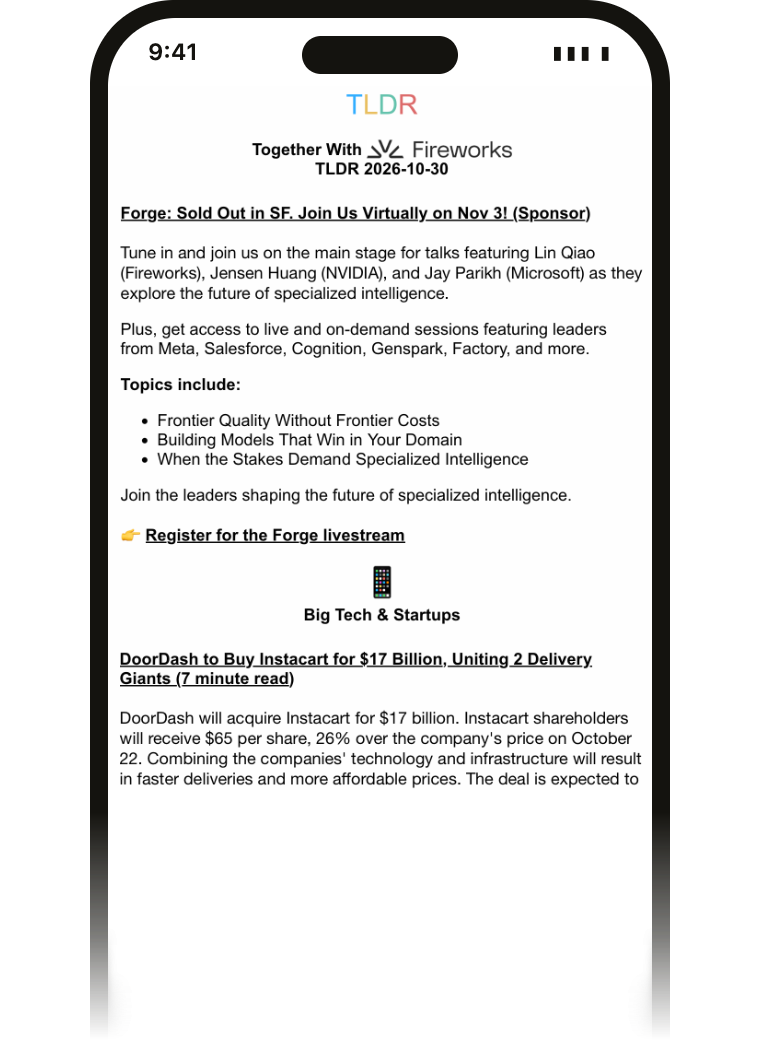
1,270 WORDS · 13 LINKED ITEMS · ARRIVED 6:26 AM ET
Subscribe to TLDR if you want the day's technology news as a triage list: around fourteen linked items, each summarized in a few plain sentences with its own read-time label, every weekday before 6:30 a.m. Eastern. Skip it if you want argument or analysis, because TLDR deliberately carries none.
| Price | Free |
|---|---|
| Paid tier | None. Every TLDR newsletter is free and there is no paywall; the company sells advertising instead of subscriptions |
| Cadence | Weekdays only, Monday to Friday. No weekend edition, and no missed weekday in our sample |
| Arrives | 6:26 to 6:43 a.m. Eastern across our sample, tightening to 6:26 to 6:31 over the final two weeks. One fixed send, not per time zone |
| Read time | 5 minutes at an ordinary reading pace |
| Length | 1,340 words median (1,217 to 1,485 across our sample) |
| Ads per issue | Three labeled sponsor blocks is the mode, 10 of 21 issues, range one to four. Ten issues also carried a TLDR house ad for its own ad inventory, labeled the same way |
| Emails / week | Five for the flagship. Thirteen sister editions exist, each a separate opt-in |
| Publisher | TLDR Media LLC, founded and owned by Dan Ni. Bootstrapped, no outside investors |
| Founded | 2018 |
| Readership | 1,600,000 on the flagship and more than 8 million across all 14 newsletters, TLDR's own published figures |
| Ad model | Advertising only. Three placement types are sold: a block at the top, one mid-issue, and one in Quick Links. Every one we measured carried '(Sponsor)' inside the headline itself |
Who should read TLDR?
TLDR says more than 70 percent of its readers are technical professionals working in AI, engineering, product or design. That shows in the editing: the summaries assume you know what a model, a repo and a funding round are, and never stop to explain them.
You want to know what shipped, what broke and what the industry is arguing about before standup, and you would rather read fourteen honest summaries than one person's opinion about three of them.
Product managers, founders and marketers who are not writing the code but have to know what just changed. The read-time labels let you take the headline and skip the 16-minute essay without guilt.
TLDR will never tell you what it thinks. If you want a point of view on the week in technology, read Stratechery or Platformer instead, and keep TLDR underneath as the wire.
What you actually get, in order
The running order did not vary once across 21 issues. Same sections, same order, same labeling, which is most of why a 1,340-word email reads in five minutes.
Why it's one of the best in its category
The story so far
TLDR started in 2018 as a side project by Dan Ni, who had founded and sold the developer tool ScraperAPI and used the proceeds to bootstrap a newsletter rather than raise money for one. Inc. has reported the origin from the basement upward, and the early growth story is unglamorous in a way that matters: the first issue went to a single reader, and the audience was built with small paid acquisition and newsletter swaps rather than a launch.
What it became is TLDR Media LLC, a remote company that now publishes 14 free daily newsletters with more than 8 million subscribers between them, of which the flagship accounts for 1.6 million. It never took outside investment, so Ni still owns it, and the whole business is advertising: three placement types per issue, a self-serve portal for small campaigns, and a sponsored-content studio on tldr.tech. The sign-off in every issue points at its own job board, and claims a place on Inc.'s list of best bootstrapped businesses for 2025.
The striking thing is how little the product has changed. The 2026 issue is the same shape as the original idea: links, a few sentences each, a read-time label, no opinion. What grew was breadth, from one newsletter to fourteen covering AI, dev, DevOps, data, security, IT, product, marketing, design, founders, fintech, crypto and hardware, and the ad load, which now reaches four labeled blocks on the heavier days. The editorial discipline that made it work is still intact.