REUTERS DAILY BRIEFING
“The wire itself, before anyone has told you what to think about it.”
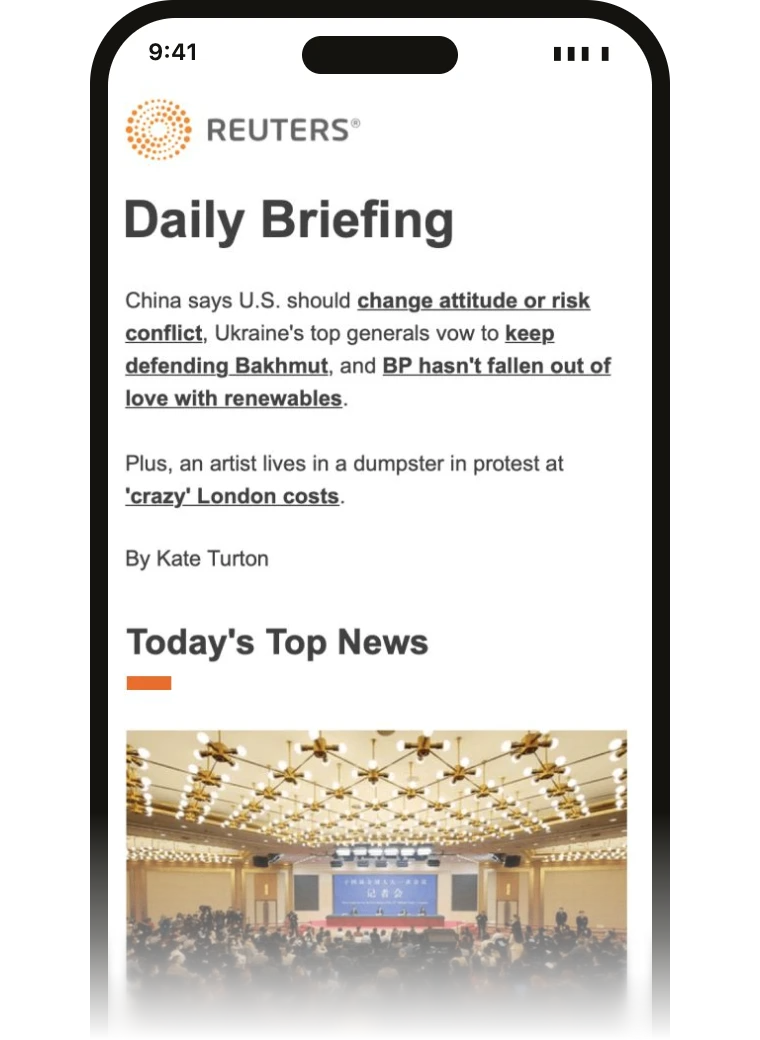
MEDIAN ISSUE: 846 WORDS · 20 LINKED STORIES · ARRIVES 6:56 TO 7:11 AM ET
Subscribe to the Reuters Daily Briefing if you want the world's news in the order a wire service ranks it: around twenty stories a morning, each in a sentence or two, with no column, no personality and nothing you have to agree with. Skip it if you want someone to explain what it all means, because the Daily Briefing almost never tries.
| Price | Free |
|---|---|
| Paid tier | None for the newsletter. Reuters.com itself runs a metered paywall, so some linked articles may ask you to subscribe; Reuters blocked our automated reads during this build, so we do not quote a current price |
| Cadence | Weekdays, Monday to Friday. All 21 weekdays in our window arrived, none missed |
| Arrives | 6:56 to 7:11 a.m. Eastern across every issue we measured, with 14 of 21 landing between 6:56 and 7:03. One fixed send, not per time zone |
| Read time | 4 minutes at an ordinary reading pace |
| Length | 846 words median (620 to 1,040 across our sample) |
| Ads per issue | Zero in 21 of 21 issues. Every issue carries an 'Advertise in this newsletter' link and a standing line that sponsors play no part in Reuters editorial, so the inventory exists; nothing ran in our window |
| Emails / week | Five. The Saturday Weekend Briefing is a separate opt-in, as are the other Reuters newsletters |
| Publisher | Reuters, the news and media division of Thomson Reuters |
| Founded | Reuters was founded in London in 1851 by Paul Julius Reuter; Thomson Reuters was formed when the Thomson Corporation acquired Reuters Group in 2008 |
| Written by | Five named editors rotated through our sample: Kate Turton (10 issues), Robert MacMillan (5), Claire Beers (4), Linda Noakes and Yasmeen Serhan (1 each) |
| Ad model | Reuters sells newsletter advertising through Reuters Professional, and separately runs a subscription business on reuters.com. Neither reached the 21 issues we measured |
Who should read Reuters Daily Briefing?
The Daily Briefing is the consumer face of a 175-year-old wire service, and it reads like one. There is no columnist, no running joke and no editorial line to pick a fight with. What it has instead is reach: in a single 846-word email we counted datelines from four continents, each one a Reuters correspondent's own reporting rather than an aggregated link.
If your morning has quietly narrowed to one country's politics, this is the fastest correction available. Four minutes, roughly twenty stories, and most of them are happening somewhere you were not looking.
Analysts, lawyers, policy staff and anyone who has to know what happened before deciding what they think about it. The absence of a point of view is the feature you are buying.
A wire briefing tells you that two trains collided and a government fell. It will not tell you why either matters this week. If that is what you want from a morning email, read Tangle or Semafor Flagship instead, and keep this underneath as the ground truth.
What you actually get, in order
The running order barely moved across 21 issues. Two named sections anchor every single one, a mid-issue feature and a light closer come and go, and the whole thing is over in four minutes.
Why it's one of the best in its category
The story so far
Reuters is the oldest brand the Review Desk has covered by more than a century. Paul Julius Reuter opened an office in London in October 1851 to move stock-market quotations down the new telegraph cables, and the business that grew out of it became the model for what a wire service is: not a newspaper with a view, but a supplier of facts that other newspapers buy. That origin explains more about the Daily Briefing than anything in the email itself. The product being sold has always been the reporting, not the opinion about it.
The modern owner arrived in 2008, when the Thomson Corporation acquired Reuters Group and the combined company became Thomson Reuters, with Reuters as its news and media division. The copyright line at the foot of every Daily Briefing still reads Thomson Reuters, from 3 Times Square in New York. The commercial context has shifted since: reuters.com went to a metered paywall in 2024, and the agency now sells consumer subscriptions alongside the terminal and professional businesses that have always paid the bills.
What has not changed is the shape of this email. Across our 21 issues it opened with world news and closed with something light, every weekday, written by a named editor, in under 900 words. The Daily Briefing is not trying to be the destination; it is trying to be the thing you read before you decide where to go. In a category that has spent five years adding personality, that restraint has quietly become the differentiator.