HARK!NEWS · THE REVIEW DESK · No. 11REVIEWSSCIENCENATURE BRIEFING
DEEP DIVE · SCIENCE

NATURE BRIEFING

“The only daily briefing we have measured that shows you the paper it is talking about.”
4.9out of 5 · Our first science pick
FREEWEEKDAYSNO ADS IN 22 ISSUES~910 WORDSARCHIVE BACK TO 2018
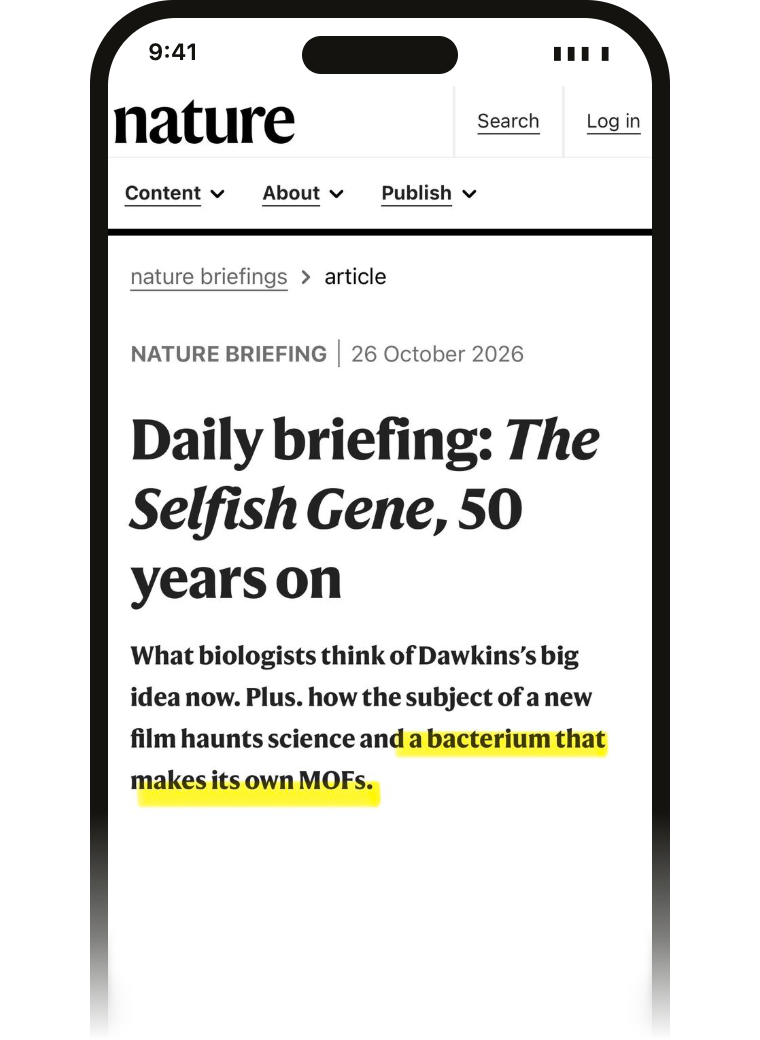
The top of the 26 October 2026 Nature Briefing, shown on an iPhone
THE MONDAY 26 OCTOBER ISSUE, AS NATURE'S FREE PUBLIC ARCHIVE RENDERS IT: THE BRIEFING LABEL, THE DATE, THE DAY'S LEAD, THEN THE PLUS LINE THAT TELLS YOU THE OTHER TWO THINGS WORTH YOUR TIME
THIS ISSUE: 730 WORDS · 9 LINKED ITEMS · 2 PRIMARY PAPERS · 72 MINUTES OF ONWARD READING
THE VERDICT

Subscribe to Nature Briefing if you want a working scientist's daily scan: eight or nine items, each one sourced and time-stamped, with the underlying paper linked so you can check the claim yourself. Skip it if you want science explained from scratch, because the Briefing assumes you can read a result without being walked to it.

BEST AT
Showing its work. Every item names the outlet it came from and how long that piece will take you, and in all 22 issues we measured at least one story carried a separate Reference line pointing at the actual paper. Nothing else in the Review Desk's daily category does this. You are never more than one click from the evidence, which in science writing is the entire ball game.
WEAKEST AT
The send time suits London and nobody else: these arrived between 11:51 a.m. and 2:37 p.m. Eastern, which is the middle of a working day rather than a morning read, the Briefing assumes a scientific literacy it never pauses to supply, and there is no audio version for those on the run.
Measured by Hark across 22 distinct weekday issues received 5 October to 3 November 2026, deduped from 236 delivered copies across 11 accounts. Word counts take the plain-text part between the greeting and the sign-off and strip URLs, so the long standing footer is excluded. Item counts are the Briefing's own 'N min read' labels, and onward-reading minutes are those labels summed. Reference counts are the lines the Briefing itself labels Reference. Cadence, send times, bylines, section names and the sponsor count are all measured from the issues. Facts about the publication itself come from the Briefing's signup page, its public archive and Nature's journal-information page, read in a browser because nature.com redirects automated fetches to a login flow. No subscriber figure is stated on any of those pages, so this review does not quote one.
THE SPEC CARD
PriceFree. The signup page offers only an e-mail field, and no paid tier of the Briefing exists
Paid tierNone. Some linked research papers sit behind journal paywalls, and 4 links across our 22 issues were flagged 'free registration required' by the Briefing itself. Nature's own news articles were not gated in the links we followed
CadenceEvery weekday. All 22 weekdays in our window arrived, none missed
Arrives11:51 a.m. to 2:37 p.m. Eastern across our sample, which is late afternoon in London. 19 of the 22 landed between 12:08 and 1:29 p.m. Eastern. One send for everyone
Read time4 minutes at an ordinary reading pace
Length910 words median (730 to 1,319 across our sample), footer excluded
Ads per issueZero in 22 of 22. The template's stylesheet carries an advertisement class in every issue and the markup never uses it, so the slot exists and stayed empty for a month
Emails / weekFive. Seven sibling Briefings (Anthropocene, AI & Robotics, Cancer, Careers, Clinical Neurology, Microbiology, Translational Research) are separate opt-ins
PublisherNature Portfolio, part of Springer Nature, from the Springer Nature Campus on Crinan Street, London
FoundedThe first issue of the journal Nature was published in November 1869. The oldest Briefing in the public archive is dated 20 August 2018
Written byFlora Graham, chief editor, signed 15 of our 22 issues; Jacob Smith, associate editor, signed the other 7. Whoever does not sign is usually credited underneath as a contributor
ArchivePublic and free: 1,972 past issues listed on nature.com, back to August 2018, readable without an account

Who should read Nature Briefing?

Nature Briefing is written for people who already work in or near science, and it does not pretend otherwise. The greeting is 'Hello Nature readers'. A typical item gives you the finding, the name of the researcher who disputes it, and a link to the paper, in about eighty words. What makes it unusual is how much of the wider field it carries: 56 of the 190 items we counted came from 35 outlets other than Nature, including Science, The Guardian, Reuters and the BBC.

★★★ THE WORKING RESEARCHER

Four minutes to see what moved in every field but your own, with the paper one click away when something lands near your work. The Careers and lab-life items (how to track your tools, whether to disclose a disability to your PI) are aimed squarely at you too.

★★★ THE SCIENCE-ADJACENT PROFESSIONAL

Clinicians, science journalists, policy staff, people at research funders and anyone who has to sound informed about a field they do not work in. You get Nature's own judgment about what mattered today without a journal subscription.

★☆☆ THE CURIOUS GENERAL READER

The Briefing will tell you that cable bacteria build their own metal-organic frameworks. It will not stop to explain what a metal-organic framework is. If you want science from first principles, this is the wrong altitude, and the better move is to read it alongside something that explains.

What you actually get, in order

The shape held across all 22 issues: a greeting, a one-sentence contents line, the news items, a features block, a quote, and a named human signing off. The whole thing is over in four minutes even though it offers about seventy minutes of onward reading.

Hello Nature readers. The same greeting in all 22 issues, followed in 21 of them by a single sentence naming the three things in today's edition. It is the fastest table of contents in the category.
The lead item. The day's biggest story, with a photograph and a caption, usually from Nature's own newsroom. The subject line is almost always this story.
The news run. Three to five more findings, each a short paragraph, each closing with its outlet and its reading time. This is where the other 35 outlets show up.
Reference lines. Under the items built on a new paper, a separate line linking the paper itself. We counted 58 across the sample, and all 22 issues had at least one.
Features & opinion. In 21 of 22. The longer reads: an essay on 50 years of The Selfish Gene, four researchers answering a reader's career dilemma, a video on saving coral reefs.
Quote of the day. Also in 21 of 22. One line from a named scientist, sourced and linked, often sharper than anything above it.
Leif Penguinson. A cartoon penguin hidden in a photograph on Fridays, with the answer published on Monday. Present in 9 of our 22 issues, which is every Friday and every Monday in the window.
The sign-off and the footer. A named editor with their job title and a working reply address, then the list of sibling Briefings, the Arabic and Chinese weekly round-ups, and one-click unsubscribe.
·
Three lighter formats rotate through the middle: an Image of the week in 5 issues of 22, an Infographic of the week in 5, and a Notable quotable in 2. The Nature Podcast was credited as the source of 5 items across the sample, so the audio lives next door rather than inside the email.

Why it's one of the best in its category

It links the paper, not just the write-up. 58 Reference lines across 22 issues, at least one in every single edition, pointing at the primary research behind the story. Every other daily we have measured asks you to take the summary on trust.
It tells you what each item will cost you. Every one of the 190 items we counted carried its own label: 7 min read, 12 min video, 32 min listen. A median issue is four minutes to read and roughly seventy minutes to follow, and the Briefing is honest about that gap up front.
Not one sponsor placement in 22 issues. We checked the markup as well as the text. The stylesheet defines an advertisement heading in all 22 issues and the markup never uses it once, so a month of this newsletter was entirely editorial.
It reads the competition. 134 of 190 items came from Nature and its sibling journals, but 56 came from 35 other outlets, among them Science, The Guardian, The New York Times, Reuters, Scientific American and the BBC. A house organ would not do that.
The archive is free, public and nineteen hundred issues deep. 1,972 past editions are listed on nature.com, back to 20 August 2018, readable without an account. You can see exactly what you are signing up for before you hand over an address, which is rarer than it sounds.

The story so far

Nature published its first issue in November 1869, which makes it the oldest title the Review Desk has covered. For most of that time its relationship with the general reader was simple: the journal published research, and newspapers told you about it. The Briefing inverts that. It is Nature's own editors reading the whole field, including their rivals, and handing you the eight things that moved, with the papers attached.

The daily email has been running since at least 20 August 2018, the date of the oldest issue in the public archive, and Flora Graham's byline is on that one too. Nineteen hundred and seventy-two issues later she is still chief editor, and across our sample she wrote 15 of 22 while Jacob Smith wrote 7. That is an unusual amount of continuity for a free product, and you can feel it in the voice: unhurried, slightly dry, comfortable saying that a result is contested.

The commercial model is the interesting part. Nature Portfolio makes its money from journal subscriptions and from publishing fees, so the Briefing does not need to sell advertising space, and across a month it sold none. The cost to the reader is different: the links are a mix of free news and paywalled research, so the Briefing can show you the paper without being able to promise you can read all of it. That is the honest trade, and it is still the best one in science email.

From last week's issues

Daily briefing: The Selfish Gene, 50 years on
26 Oct 2026 · the issue in the clip above · 730 words, 9 linked items
Daily briefing: The tell-tale features of a Denisovan
22 Oct 2026 · 5 primary-paper references, the most in our sample
Daily briefing: The three red flags of suspicious journals
29 Oct 2026 · written by Jacob Smith · 4 references

Questions readers ask

Is Nature Briefing free? Yes. The signup page asks for an e-mail address and nothing else, and there is no paid tier of the newsletter. You do not need a nature.com account or a journal subscription to receive it. Some of the research papers it links to sit behind journal paywalls, and the Briefing flags the ones that need free registration: we counted 4 such flags across 22 issues.
How long does it take to read? Four minutes. The median issue in our 22-issue sample ran 910 words, from 730 to 1,319, excluding the footer. If you followed every link instead, a median issue offered about seventy minutes of further reading, because each item carries its own time label.
How many emails will I get? Five a week, one each weekday. Nature runs seven other Briefings (Anthropocene, AI & Robotics, Cancer, Careers, Clinical Neurology, Microbiology and Translational Research), plus a weekly round-up in Arabic and one in Chinese via WeChat. Each is a separate opt-in, so signing up for the daily gets you the daily only.
What time does it arrive? Late in the London afternoon, which is the awkward part if you are not in Europe. Across our sample it landed between 11:51 a.m. and 2:37 p.m. Eastern, with 19 of the 22 issues arriving between 12:08 and 1:29 p.m. It is a single send, so there is no local-morning version.
Can I change the delivery time? No. The footer lets you choose which Nature Briefings you receive, not when they arrive. If you want this one at an hour that suits your morning rather than London's afternoon, that is the gap Hark fills.
Does it have ads? Not in any of the 22 issues we measured. We looked at the underlying markup as well as the text: the template defines a heading style for advertisements in every issue and never once applies it. Nature Portfolio earns its money from journals rather than from this inventory, which is the likeliest reason.
Who writes Nature Briefing? Flora Graham, its chief editor, and Jacob Smith, an associate editor, on a rotation: Graham signed 15 of our 22 issues and Smith the other 7, with the one who did not sign usually credited as a contributor underneath. The publisher is Nature Portfolio, part of Springer Nature.
Do I need to be a scientist to read it? No, but it helps. The Briefing explains a finding, not the field around it, so a sentence about metal-organic frameworks or antimatter traps arrives without a primer. Readers who want the context built in will get more from a general science newsletter; readers who can already follow a result will find this the fastest way to keep up with the rest of science.
Can I read past issues before subscribing? Yes, and this is one of the best things about it. Nature keeps 1,972 Briefings in a public archive on nature.com going back to 20 August 2018, readable without an account. Read a week of them and you will know exactly whether this is for you.
Is Nature Briefing worth it? For four minutes a weekday at no cost, with the primary paper linked and no advertising in a month of issues, yes. The one thing to plan around is the arrival time, which is built for a London afternoon rather than your morning.
HOW IT SOUNDS IN HARK
Hear this newsletter read aloud, blended with the others you already get. Five minutes, every morning, at a time you choose, without connecting your inbox.
Make your own, free