HARK!NEWS · THE REVIEW DESK · No. 4REVIEWSBUSINESS & FINANCE MONEY STUFF
DEEP DIVE · BUSINESS & FINANCE

MONEY STUFF

Wall Street's inner workings, explained daily by the only writer who makes securities law funny.

4.9out of 5 · The finance essential
FREE18 MIN READWEEKDAYS300K+ READERSEST. 2013
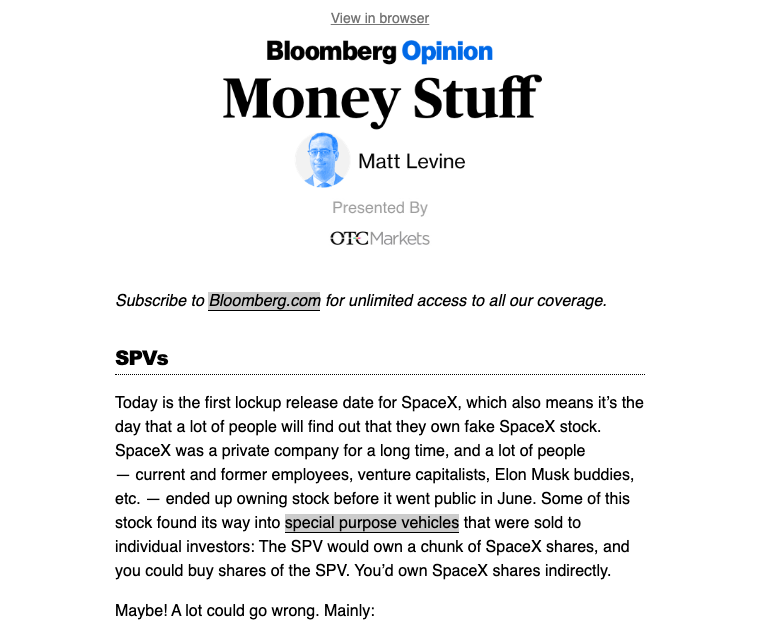
The top of a recent Money Stuff issue: Matt Levine's byline and the SPVs essay on fake SpaceX stock
A RECENT ISSUE, AUGUST 2026
WEEKDAYS · FREE · ONE SPONSOR SLOT
THE VERDICT

Subscribe to Money Stuff if you want to actually understand the machinery behind the day's finance news, taught by someone who built that machinery and thinks it's hilarious. Skip it if you only have five minutes; this is the longest, densest read in your inbox, and that's the point.

BEST AT
Turning the most complicated story in finance into a mechanism you genuinely understand. Levine structured derivatives at Goldman and practiced M&A law at Wachtell before writing, so the explanations come from someone who has done the thing, delivered with running jokes ("everything is securities fraud") that have entered the industry's vernacular.
WEAKEST AT
Length. Essay issues in our sample averaged about 4,300 words, weekdays, and there is no official audio edition; miss a few days and the pile-up is real.
THE SPEC CARD
PriceFree by email
Paid tierNone; the same column also runs on Bloomberg.com with a subscription
CadenceWeekdays (measured: four consecutive essay days, plus a short Friday podcast note)
ArrivesJust after 11 am Pacific in every sampled issue (10:47 to 11:24 am)
Read timeAbout 18 minutes per essay issue (measured 3,861 to 4,817 words)
Structure3 to 5 titled essays plus the "Things happen" link roundup, every issue
Links72 to 79 per essay issue
PublisherBloomberg (Bloomberg Opinion)
Founded2013, when Levine joined Bloomberg Opinion
ReadershipAbout 300,000 subscribers as reported in 2024; a 2025 profile put readers at 500,000
Ad modelOne "Presented by" sponsor slot up top plus a small programmatic unit; the essays themselves are never interrupted
Measured from five consecutive real issues (July 31 to August 6, 2026) forwarded to our review desk: word counts, section names, arrival times, link counts, and ad slots are observed, not estimated. Biographical and readership facts verified in cited coverage, August 2026.

Who should read Money Stuff?

Money Stuff is the closest thing finance has to a shared daily text: roughly 300,000 subscribers, a readership estimated at half a million, and a decade of being the first thing forwarded around trading desks when something weird happens in markets.

★★★ THE FINANCE PROFESSIONAL

This is the industry's water cooler. When something strange happens in markets, the question on the desk is what Levine will say about it tomorrow.

★★★ THE CURIOUS GENERALIST

No jargon is assumed; every mechanism is built from scratch in plain English, and the jokes carry you through the dense parts. This is the best free finance education on the internet.

★☆☆ THE FIVE-MINUTE SKIMMER

Four thousand words a day is the product, not a flaw. If you want finance in headline form, read Morning Brew and let Levine go.

What you actually get, in order

Each issue is a set of self-contained essays on whatever was most interesting in finance yesterday, then a link roundup. Our sampled section titles ran from "SPVs" and "OpenAI margin loan" to "Hedgehog Hedge Fund" and "Dentists!"

01
The lead essay. The day's most interesting mechanism, explained from first principles: in our sample, fake SpaceX stock sold through special purpose vehicles, and a leveraged ETF crash-hedging ETF.
02
Two to four more essays. Shorter but complete: taxes, tick sizes, sports gambling, an FBI crypto theft. Each stands alone; skipping one costs you nothing.
03
"Things happen." The closing link roundup, in every sampled issue: a dozen-plus one-line links to everything he didn't essay about.
04
The Friday podcast note. Some Fridays the email is a short pointer (165 words in our sample) to the Money Stuff podcast episode instead of a full edition.
·
Read the lead essay and skim "Things happen" and you're smarter in eight minutes; read it all and you got a finance seminar for free.

Why it's one of the best in its category

The credentials are the product. Harvard classics, Yale Law, M&A at Wachtell Lipton, equity derivatives structuring at Goldman Sachs, then writing. He explains the machine as someone who operated it.
The industry itself reads it. Roughly 300,000 subscribers with readership estimated at 500,000, and it functions as finance's common reference point; his catchphrases are how the industry talks about itself.
It's famously free. Bloomberg keeps the email edition outside its paywall, which financial media has puzzled over for years. The result is the best price-to-quality ratio in the category by a wide margin.
Depth without gatekeeping. Nothing is dumbed down and nothing assumes prior knowledge, a combination almost nobody else pulls off at a daily cadence.

The story so far

Matt Levine took the scenic route to becoming finance's favorite writer: a classics degree at Harvard, Yale Law School, mergers and acquisitions at Wachtell Lipton, then four years structuring equity derivatives at Goldman Sachs. He started blogging at Dealbreaker in 2011 and joined Bloomberg Opinion in 2013, where the column became Money Stuff.

The newsletter version became Bloomberg's flagship: the rare daily where the length is the draw, delivered free by email while nearly everything else at Bloomberg sits behind one of media's most expensive paywalls. Reported subscriber counts have climbed from 150,000 in 2021 to about 300,000 in 2024, with a 2025 Harvard Magazine profile putting readers at half a million.

Since 2022 there's also the Money Stuff podcast, co-hosted with Bloomberg's Katie Greifeld, which is what the short Friday editions in our sample point to. The email remains the main event: one writer, every weekday, still free.

Questions readers ask

Is Money Stuff free? Yes. The email edition is free, no Bloomberg subscription required. The same column also runs on Bloomberg.com, where a subscription applies to the site itself.
How long does it take to read? About 18 minutes for a full issue: our five-issue sample measured 3,861 to 4,817 words per essay edition. The occasional Friday podcast note is under a minute.
How many emails will I get? One per weekday. In our sample week that meant four full essay editions and one short Friday note pointing to the podcast.
Can I change the delivery time? No; it arrives on Bloomberg's schedule, just after 11 am Pacific in every issue we measured.
Is it too advanced for a beginner? No, and that's the trick: every mechanism is explained from scratch in plain English. It is long, not hard.
Who writes it? Matt Levine, a former Wachtell Lipton M&A lawyer and Goldman Sachs equity derivatives structurer, at Bloomberg Opinion since 2013. It is one writer, not a staff product.
Why does Bloomberg give it away? Officially unexplained, famously debated. The practical answer: it is the best top-of-funnel advertisement Bloomberg has, and the email's reach is the point.
How do I unsubscribe? One click via the link at the bottom of any email.
HOW IT SOUNDS IN HARK
Love the ideas but can't spend 18 minutes reading? Hark turns the newsletters you already get into a morning audio newscast. Five minutes, every morning, without connecting your inbox.
Make your own, free