HARK!NEWS · THE REVIEW DESK · No. 7REVIEWSPRODUCT & STARTUPS LENNY'S NEWSLETTER
DEEP DIVE · PRODUCT & STARTUPS

LENNY'S NEWSLETTER

The product manager's newsletter of record, one deep essay a week.

4.8out of 5 · The deepest weekly read in product, and the most paywalled
PAID, $275/YR15 MIN READWEEKLY1.2M+ SUBSCRIBERSEST. 2019
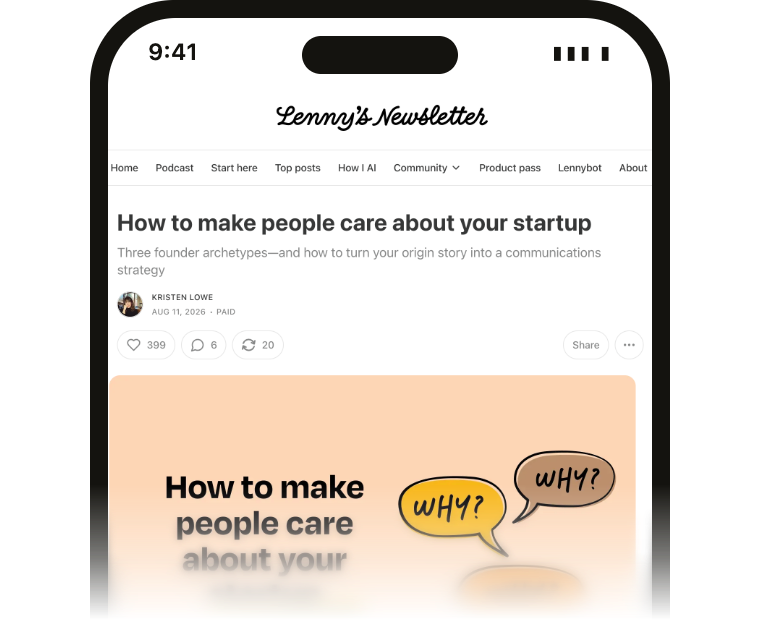
Lenny's Newsletter's August 11, 2026 issue on an iPhone: the masthead nav, the headline 'How to make people care about your startup', the subtitle on three founder archetypes, and Kristen Lowe's guest byline marked PAID
A TYPICAL TUESDAY ISSUE, AUGUST 2026
AUG 11, 2026 · 5,969 WORDS · 0 SPONSOR BLOCKS · GUEST POST · PAID
THE VERDICT

Subscribe to Lenny's Newsletter if you build, grow, or manage products and want one weekly essay that is more useful than most courses, plus the biggest peer community in the field. Skip it if you are not in tech or product; it is written for practitioners, and its best material is paid.

BEST AT
Depth and credibility. Each essay is a long, researched playbook, often built from surveys of hundreds of operators, and the guest posts come from the people who did the thing. Our sample averaged 4,014 words a deep dive, with no sponsor block anywhere in it, and the paid Slack runs past 30,000 product people.
WEAKEST AT
Narrow by design (product and growth at software companies), nearly everything worth reading now sits behind the $275 paywall, and there is no audio version for those on the run.
Measured by Hark across 80 posts from Lenny's Newsletter's public Substack archive, December 2024 to August 2026: per-post word counts, free-versus-paid split, publish days and times, and the section structure are read from the archive API and the rendered posts, not estimated. Prices, tier benefits and subscriber counts verified on the live subscribe page, August 18, 2026.
THE SPEC CARD
PriceFree tier exists but is thin; paid is $28 a month or $275 a year on the live subscribe page, with a founding Insider tier at $400 a year
Paid tierEvery deep dive and the full archive, a private Slack the site puts at 30,000-plus PMs and founders with meetups and AMAs, and Product Pass: free access to 30-plus premium AI and product tools that the page values at $30,000-plus
CadenceWeekly on Tuesdays: all 16 of the most recent posts landed on a Tuesday, median gap exactly 7 days, with occasional 13 to 14 day gaps where a week is skipped
ArrivesTuesday mornings US time, 8:45 to 11:03 am ET across our sample (12:45 to 15:03 UTC)
Read timeAbout 15 minutes; the paid deep dives averaged 4,014 words (roughly 17 minutes at 240 words a minute) and the longest in our sample ran 5,969 words, about 25 minutes
Length933 to 5,969 words across the 10 most recent posts (average 3,634, median 4,360); the short ones are announcements, not essays
Ads per issueZero. No sponsor block appeared in any issue we read, and Substack's own page config has sponsorship campaigns switched off
Emails / weekAbout 1, and some weeks none: 80 posts across the 20 months we sampled
PublisherIndependent (Lenny Rachitsky), published on Substack
Founded2019
ReadershipOver 1,200,000 subscribers per its own page header, their figure; Substack's own payload describes the paid side as tens of thousands of paid subscribers and gives it a bestseller badge at the 10,000-plus tier
Ad modelPaid subscriptions, plus a separate podcast; it sells no ads, so the paywall is the business model. Substack-hosted; we make no claim about email handling beyond that

Who should read Lenny's Newsletter?

Lenny's Newsletter is written for people who work in product, growth, and startups: PMs, founders, designers, marketers and engineers who want frameworks, benchmarks and templates from operators. Its own page header reads over 1,200,000 subscribers, and Substack reports tens of thousands of them pay.

★★★ THE PRODUCT MANAGER

It is the closest thing product management has to a canon: 4,000-word playbooks on roadmaps, interviews and metrics, sourced from people who ran them.

★★★ THE FOUNDER OR OPERATOR

Growth loops, pricing, hiring, AI for product teams; the guest posts are operators showing their work, not pundits. The Slack and the tool credits make the $275 easier to justify.

★☆☆ THE GENERAL BUSINESS READER

If you are not building software products, most of it will not apply, and the free tier will not carry you. Read Morning Brew for business news instead.

What you actually get, in order

Lenny's is not sectioned like a daily; each issue is one essay, and the headers are the essay's own argument. The shape below is what every issue we read shares, using the real headers of the August 11, 2026 guest post on founder storytelling.

01
Headline and subtitle. The subtitle does real work: it states the framework you are about to get, e.g. three founder archetypes and how to turn an origin story into a communications strategy.
02
The byline. Often a named guest operator rather than Lenny (Kristen Lowe on the specimen issue), marked PAID next to the date.
03
A framing intro. Why this problem matters and what the reader will be able to do afterwards; usually a few hundred words before the first header.
04
The framework, named. The spine of the piece, e.g. 'The three founder archetypes'. Almost every essay hands you a named model rather than observations.
05
One section per part. The archetypes run in order, each with its own header, examples and quotes from named operators.
06
A playbook per part. Each section closes with an explicit 'playbook' header: the steps to actually run it. This is the part readers screenshot.
07
The paywall. Non-subscribers get roughly the first framework, then 'This post is for paid subscribers'. On free posts there is no cut at all.
08
Diagrams and screenshots. Visual essays are common: the free April 2026 piece we read carried 16 images across twelve numbered lessons.
09
Discussion and 'Ready for more?' Comments (the specimen issue drew 399 reactions, 6 comments, 20 restacks) then the archive and subscribe rail.
·
There is no skim path: an issue is a 15 to 25 minute sit-down, which is exactly why so many of them go unread in a busy week.

Why it's one of the best in its category

Length that is actually earned. The paid deep dives in our sample averaged 4,014 words and ran as long as 5,969, and they are structured as playbooks with named steps, not padded posts. Most newsletters at this length are newsletters; these read like short courses.
Nothing is for sale inside the issue. We found zero sponsor blocks in every issue we read, and Substack's own page config has sponsorship campaigns disabled. Reader money funds it, so nothing in the essay is bought.
A community, not just a letter. The subscribe page puts the paid Slack at 30,000-plus PMs, founders and leaders, with meetups, AMAs and mentorship. For a working PM that network is arguably worth more than the essays.
Written by an operator, sourced from operators. Seven years leading growth at Airbnb, then essays built on surveys and interviews with hundreds of PMs and founders, plus guest posts from the people who ran the playbook.
It kept the format. Over 1,200,000 subscribers later, it is still one long essay at a time, on the same Tuesday, with no ads. Growth has changed the business, not the product.

The story so far

Lenny Rachitsky left Airbnb in 2019 after seven years leading work on supply growth, conversion, trip quality and community, and started answering questions from other product people. The answers became a newsletter in April 2019. An eight-part series on building marketplaces was the first big effort, and two long posts in year one drove about half of his early subscribers. He turned on paid, reached 500 paying readers and roughly $65,000 a year, and kept going.

Growth compounded through Substack's recommendations, which at one point drove 78 percent of new subscribers from more than 1,000 other newsletters, and through a reputation for essays more useful than most courses. Reported milestones: about 377,000 free and 18,000 paid subscribers by April 2023, roughly $2 million a year; 500,000 total by September 2023; 1,000,000 by March 2025. Its own page header now reads over 1,200,000 subscribers, and a podcast that Lenny has said out-earns the newsletter runs alongside it.

What has changed is where the value sits. Our archive sample found 20 free posts out of 80, and only 2 of the 10 most recent, both product announcements rather than essays. The subscribe page now describes the free tier as occasional posts, while the weekly deep dives, the 30,000-plus Slack and the Product Pass tool credits sit behind $275 a year. What has not changed is the issue itself: one long, researched essay, no ads, guest posts from operators.

From last week's issues

How to make people care about your startup
Aug 11, 2026 · paid · 5,969 words · guest post by Kristen Lowe on three founder archetypes
What if you're not supposed to have a long-term plan?
Aug 4, 2026 · paid · 4,925 words · on careers built without a five-year plan
A visual guide to getting out of a creative slump
Apr 7, 2026 · free · twelve numbered lessons across 16 illustrations

Questions readers ask

Is Lenny's Newsletter free? There is a free tier, but it is thin. Across the 80 posts we measured, 20 were free, and only 2 of the 10 most recent, both product announcements rather than essays. Lenny's own subscribe page calls it occasional free newsletter posts. The weekly deep dives are paid.
How long does it take to read? About 15 minutes. The paid deep dives in our sample averaged 4,014 words, roughly 17 minutes at a normal reading pace, and the longest ran 5,969 words, about 25 minutes.
How much does Lenny's Newsletter cost? The live subscribe page shows $28 a month or $275 a year, with a founding Insider tier at $400 a year. The annual price includes the Slack community and Product Pass, the bundle of 30-plus AI and product tools the page values at $30,000-plus.
How many emails will I get? About one a week, on a Tuesday. All 16 of the most recent posts we checked published on a Tuesday, with a median gap of exactly 7 days and the occasional skipped week.
What is Product Pass? A bundle included with the annual subscription: free access to 30-plus premium AI and product tools, which the subscribe page values at more than $30,000. If you are going to pay for the newsletter, it is the tier that makes the price argue for itself.
Is it only for product managers? It is written for product and growth people, but founders, designers, marketers and engineers at software companies get most of the value. Outside software, very little of it will apply.
Is Lenny's Newsletter worth it? If product or growth is your job, yes: one 4,000-word playbook a week, no ads, plus a 30,000-person Slack, is a fair trade for $275. If you only read the free posts, you will mostly receive announcements.
Who writes Lenny's Newsletter? Lenny Rachitsky, a former Airbnb product lead, independently on Substack, with frequent guest authors (the August 11, 2026 issue was written by Kristen Lowe) and a companion podcast.
How do I unsubscribe? One click via the link at the bottom of any issue.
HOW IT SOUNDS IN HARK
A 20-minute Lenny essay is exactly the kind of read that piles up unread. Hark turns the week's essays into a segment you actually hear, in five voiced minutes, without connecting your inbox.
Make your own, free