HARK!NEWS · THE REVIEW DESK · No. 1REVIEWSBUSINESS & FINANCE MORNING BREW
DEEP DIVE · BUSINESS & FINANCE

MORNING BREW

The best first business newsletter, and a redundant second one.

4.8out of 5 · First review in our business & finance series
FREE5 MIN READ7× / WEEK3 ADSNO PAYWALL
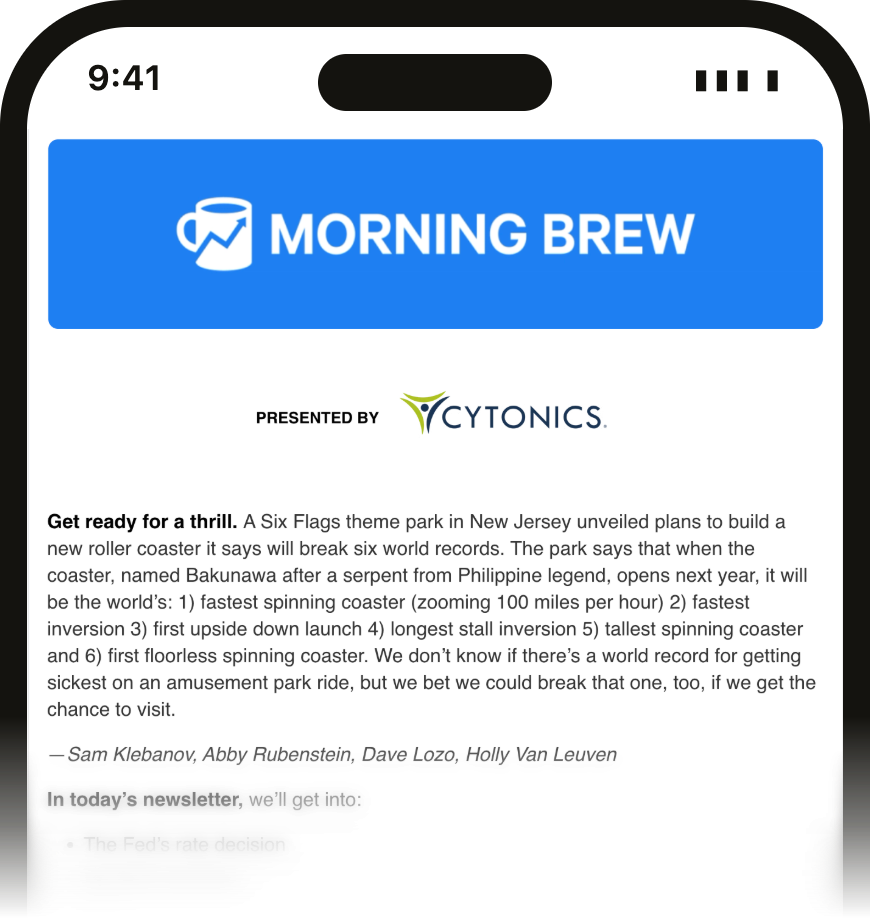
The top of Morning Brew's July 30, 2026 issue on an iPhone: the Morning Brew masthead, a Presented By sponsor line, and the opening story
A TYPICAL THURSDAY ISSUE, JULY 2026
2,465 WORDS · 3 SPONSORED BLOCKS
THE VERDICT

Subscribe to Morning Brew if you want one free email that leaves you conversationally fluent in the business day and you don't mind sponsored blocks on the way. Skip it if you already read a daily financial paper; it summarizes the same morning, more gently.

BEST AT
Making unfamiliar business news feel obvious in one pass, with witty, creative writing from a strong bench of named journalists. The quick, fun trivia, games, and puzzles at the end are a genuine daily pleasure.
WEAKEST AT
Depth on any single story, and no audio version for those on the run.
THE SPEC CARD
PriceFree
Paid tierNone
CadenceDaily, “every day of the week”
Arrives~6:00 a.m. ET, fixed
Read time5 minutes
Length~2,300 words
Ads per issue3 labeled blocks (2–3)
Emails / week7
PublisherMorning Brew Inc. (Axel Springer)
Founded2015
Readership4M+ readers (their claim)
Ad modelAd-funded; sponsors labeled in-issue
Measured by Hark across 10 issues from Morning Brew's public archive, July 2026.

Who should read Morning Brew?

People who need to sound informed about business without making business their hobby. It assumes no finance background and explains terms as it goes, which makes it the best first business newsletter and a poor second one. Morning Brew itself says its focus is U.S. news, with more than 90% of readers U.S.-based.

★★★ THE EARLY-CAREER PROFESSIONAL

Two years into a job where people cite earnings calls in meetings. This is the fastest way to stop nodding along.

★★★ THE TIME-POOR PARENT

Reads in the minutes before the school run. Ends cleanly, with no rabbit holes and no 40-minute essay.

★☆☆ THE MARKETS PROFESSIONAL

You will already know everything in it by 6 a.m. Read Matt Levine's Money Stuff or a markets daily instead.

What you actually get, in order

Every issue follows the same recurring structure, which is most of why it reads fast for its length: you learn the shape once and never re-learn it.

01
Intro note. A light editorial welcome plus “In today's newsletter” bullets.
02
Markets. Index levels and a few lines on why, sometimes with its own inline sponsor.
03
The lead story. ~250–500 words under an all-caps kicker; the most depth in the issue.
04
Sponsored block. Labeled “Sponsored By,” written in house voice.
05
“Tour de headlines.” Three world/business shorts, the workhorse of the issue.
06
Mid features. One or two more stories, plus a weekday franchise column (e.g. “Molly explains the internet” on Thursdays).
07
Second sponsored block. Where the ad load starts to be felt.
08
“What else is brewing.” A rapid bullet list of everything that didn't get a story.
09
Recs. Links and product picks, including a disclosed affiliate item.
10
Games. Brew Mini, “Three Headlines and a Lie,” Word of the Day. Genuinely good, and the reason retention is high.
·
Read the lead and the shorts and the news is done in about five minutes; the back half is games and recs.

Why it's one of the best in its category

A real newsroom, not an aggregator. A multi-desk editorial operation with named writers bylining every issue; the July 30 edition credits four.
Scale you can verify. Its own subscribe page advertises 4M+ readers, among the largest business newsletters in existence.
Consistency. Publishing daily since 2015, with zero missed days across our 10-day sample, Saturdays and Sundays included.
Explains without condescending. Acronyms are unpacked in-line; no assumed prior reading.
Ads are labeled, always. Every sponsored unit in our sample carried an explicit “Sponsored By [advertiser]” or “Presented By” header, with no native-ad ambiguity.

The story so far

Morning Brew started in 2015 as a University of Michigan student project by Alex Lieberman and Austin Rief, growing out of a 2014 precursor called Market Corner. The pitch was simple: business news for people who found The Wall Street Journal dry, written the way a sharp friend would explain it.

It worked at improbable scale. Axel Springer, the German media giant that also owns Business Insider and Politico, took a majority stake in late 2020 at a reported valuation around $75 million and completed a full buyout in February 2025. The company now runs roughly 20 franchise brands, from Marketing Brew and Retail Brew to IT Brew, CFO Brew and a slate of podcasts, and was reported to be on track to surpass $70 million in revenue for 2025.

Through all of it, the flagship newsletter has kept the same shape: free, ad-funded, daily, and deliberately unintimidating. That consistency is a big part of why it remains the default first business newsletter for each new class of professionals.

From last week's issues

Questions readers ask

Is Morning Brew free? Yes, entirely. There's no paid tier; it's funded by sponsored blocks inside each issue.
How long does it take to read? About five minutes for the news: the lead story plus the shorts. The games and recs at the end can add a few more if you linger.
How many emails will I get? Seven a week per its current schedule, plus sister newsletters (Marketing Brew, Retail Brew, IT Brew, CFO Brew and others) you must opt into separately.
Can I change the delivery time? No. Morning Brew's FAQ says time-zone-based sending isn't supported; everyone gets it on the East Coast clock.
Is it biased? Morning Brew says it takes no political stance and keeps an unbiased, informative posture; its coverage is U.S.-centric (90%+ of readers are U.S.-based, per its FAQ). Worth knowing: sponsored copy is written in the same house voice as editorial.
Is Morning Brew worth it? For most readers, yes: it's free, takes about five minutes, and is the best first business newsletter we've reviewed. The main exception is anyone who already reads a daily financial paper, since it covers the same morning in a gentler register.
Who owns Morning Brew? Axel Springer, the German media company that also owns Business Insider and Politico. It took a majority stake in late 2020 and completed a full buyout of Morning Brew Inc. in February 2025.
How do I unsubscribe from Morning Brew? One click: there's an unsubscribe link at the bottom of every issue, per Morning Brew's own FAQ.
HOW IT SOUNDS IN HARK
Hear this newsletter read aloud, blended with the others you already get. Five minutes, every morning, without connecting your inbox.
Make your own, free
ALL REVIEWS · VERIFIED JUL 30, 2026